Battings – they can make a difference!

Everyone always asks “Is this batting okay?”  And I always say, “I’ll use whatever you hand me.”  BUT  I have my favorite!  And I’m going to tell you why.

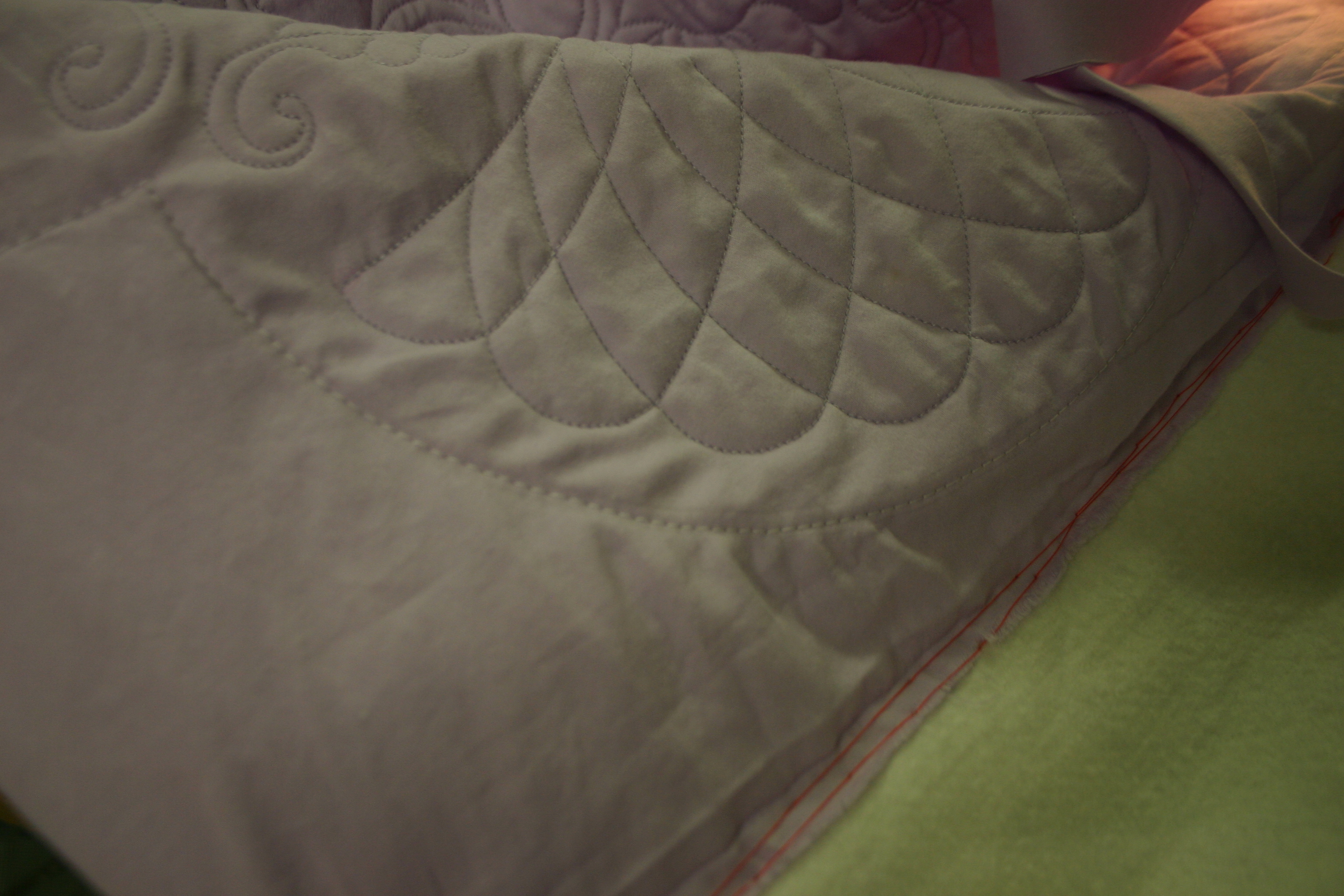
I love Quilter’s Dream – any of their battings!   They are so soft – if they held up, I’d wrap up in the batting alone.  I never have to worry about the batting being scrunched at the end of the roll as it comes nicely folded.  They lay out nice & flat – no puckers.  They are evenly weighted.  This is critical!  Many battings are thick & thin in spots – wrecks havoc with the thread tension causing pokeys generally on the back side, but none the less not good.

I realize that having a coupon for Joann’s means getting batting for a whole lot less but please consider how much you’ve spent on the fabric, how much time you’ve spent sewing it together and then seriously consider going to your local quilt shop and getting Quilter’s Dream batting.  You won’t regret how great your quilt will look & feel.

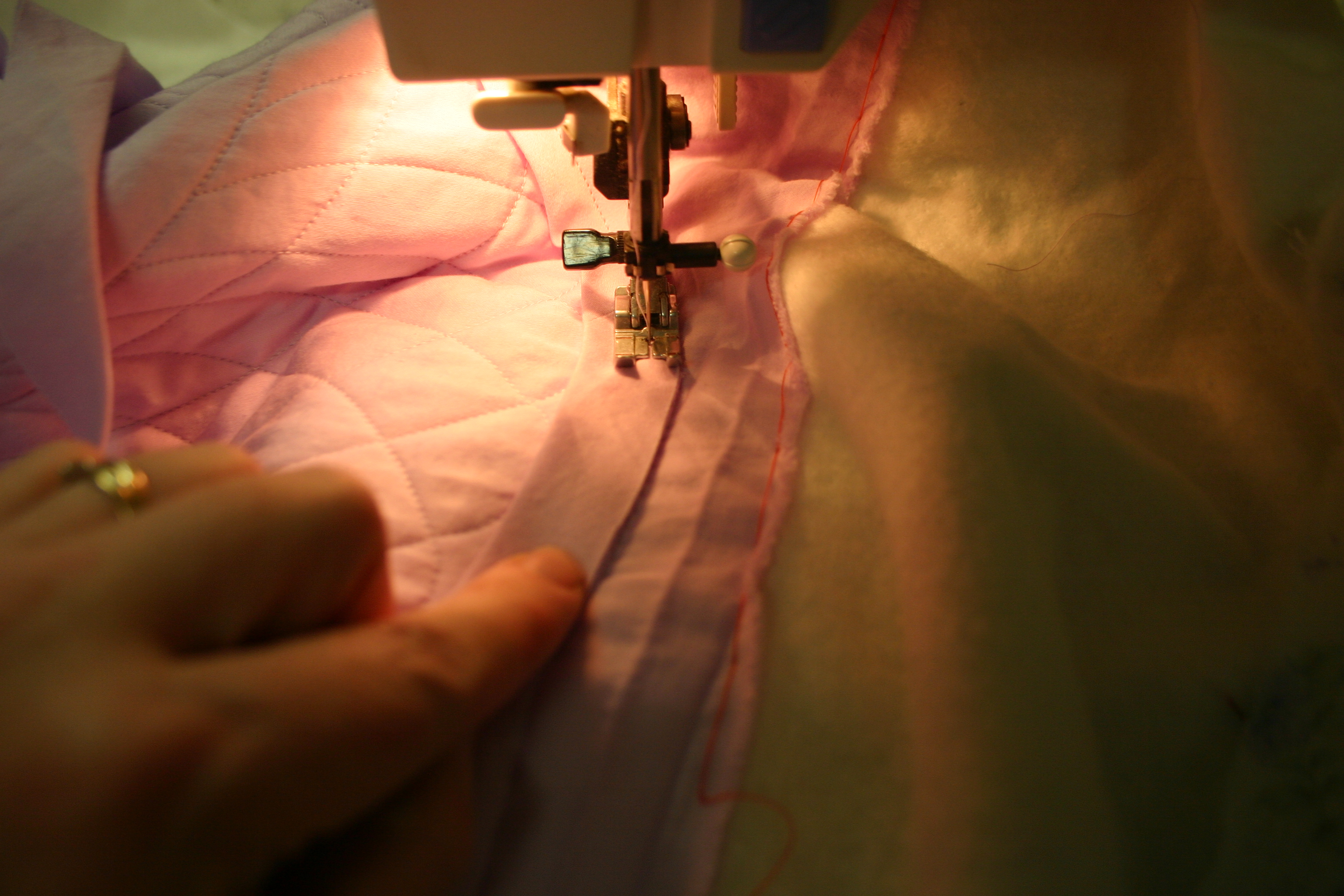
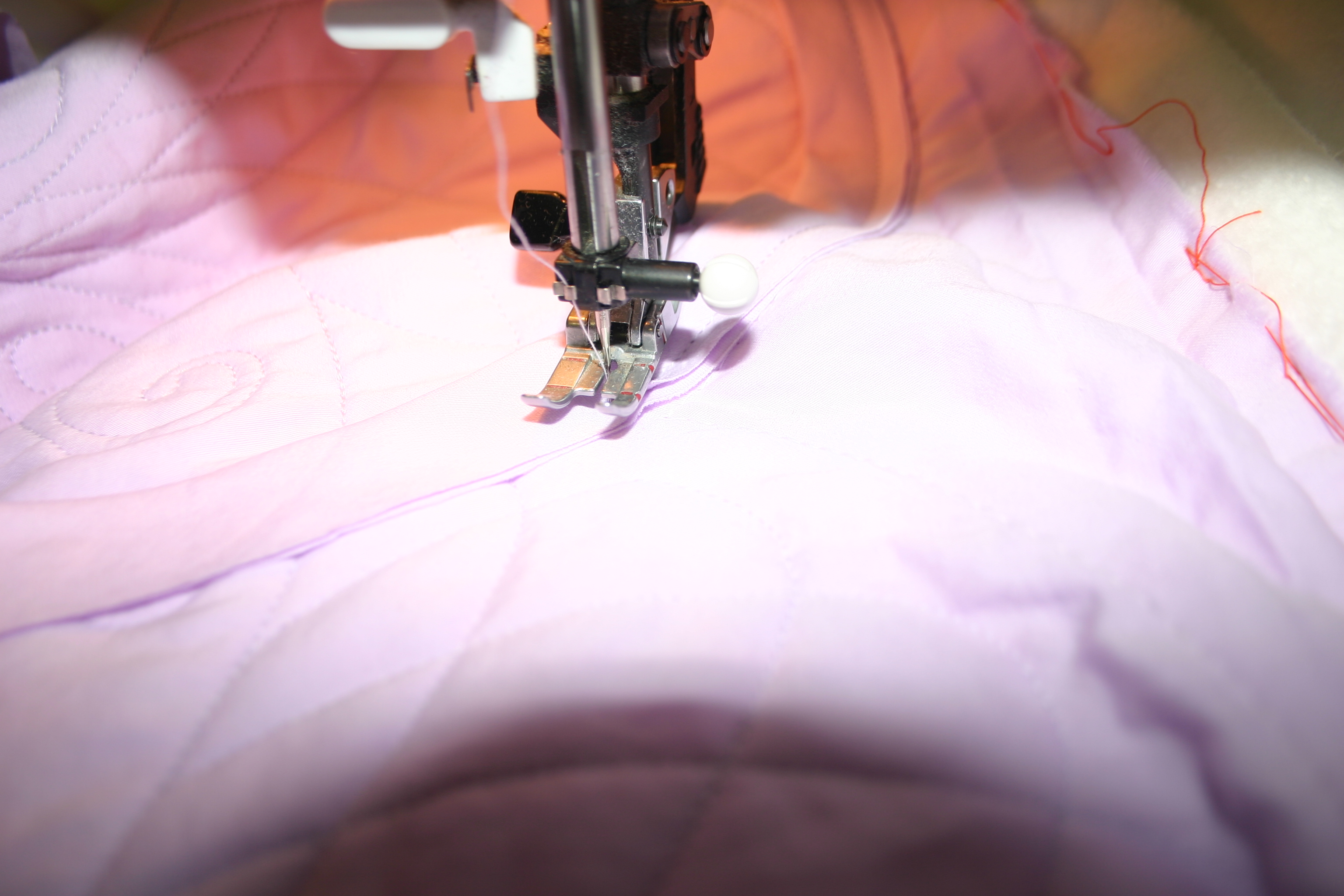
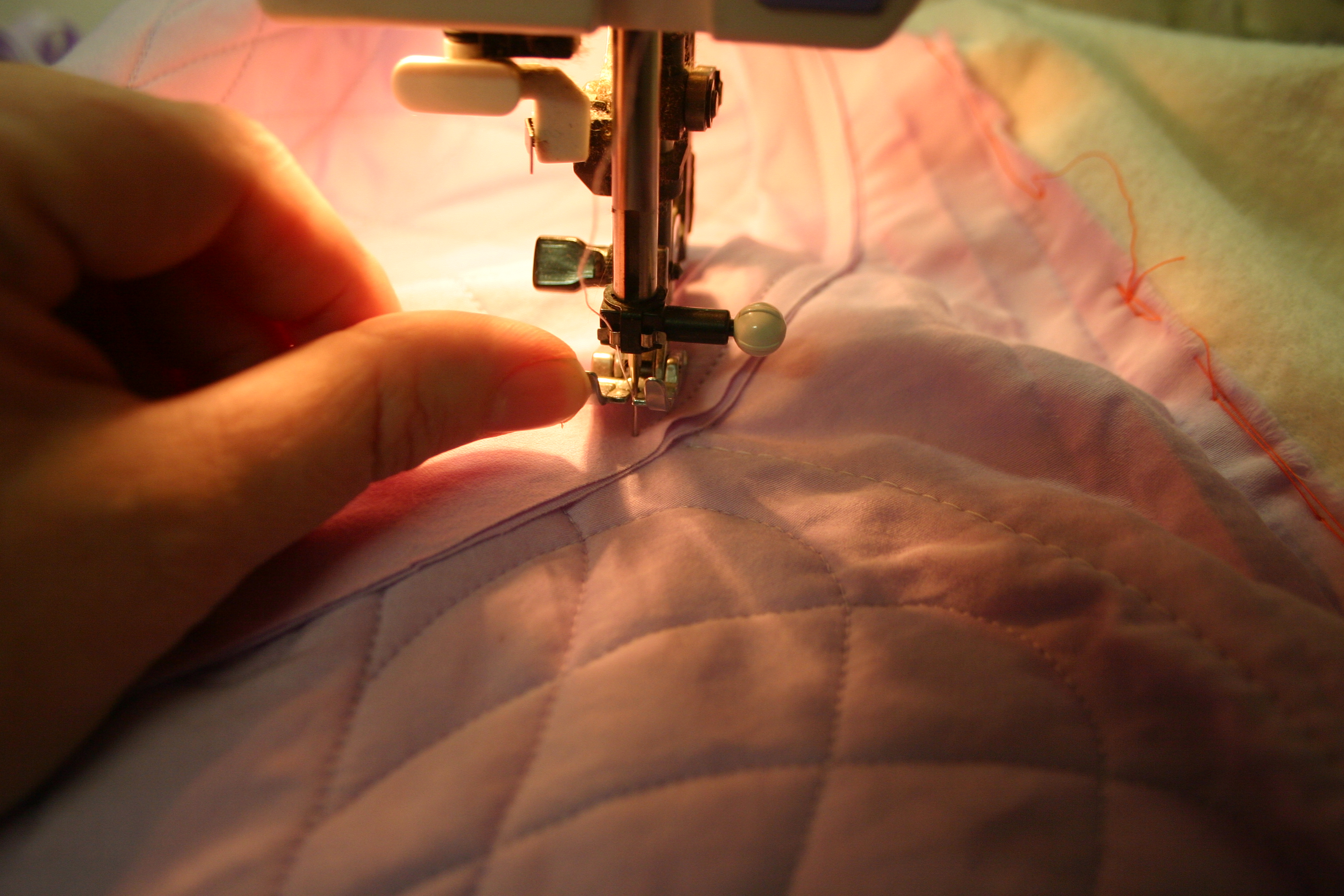
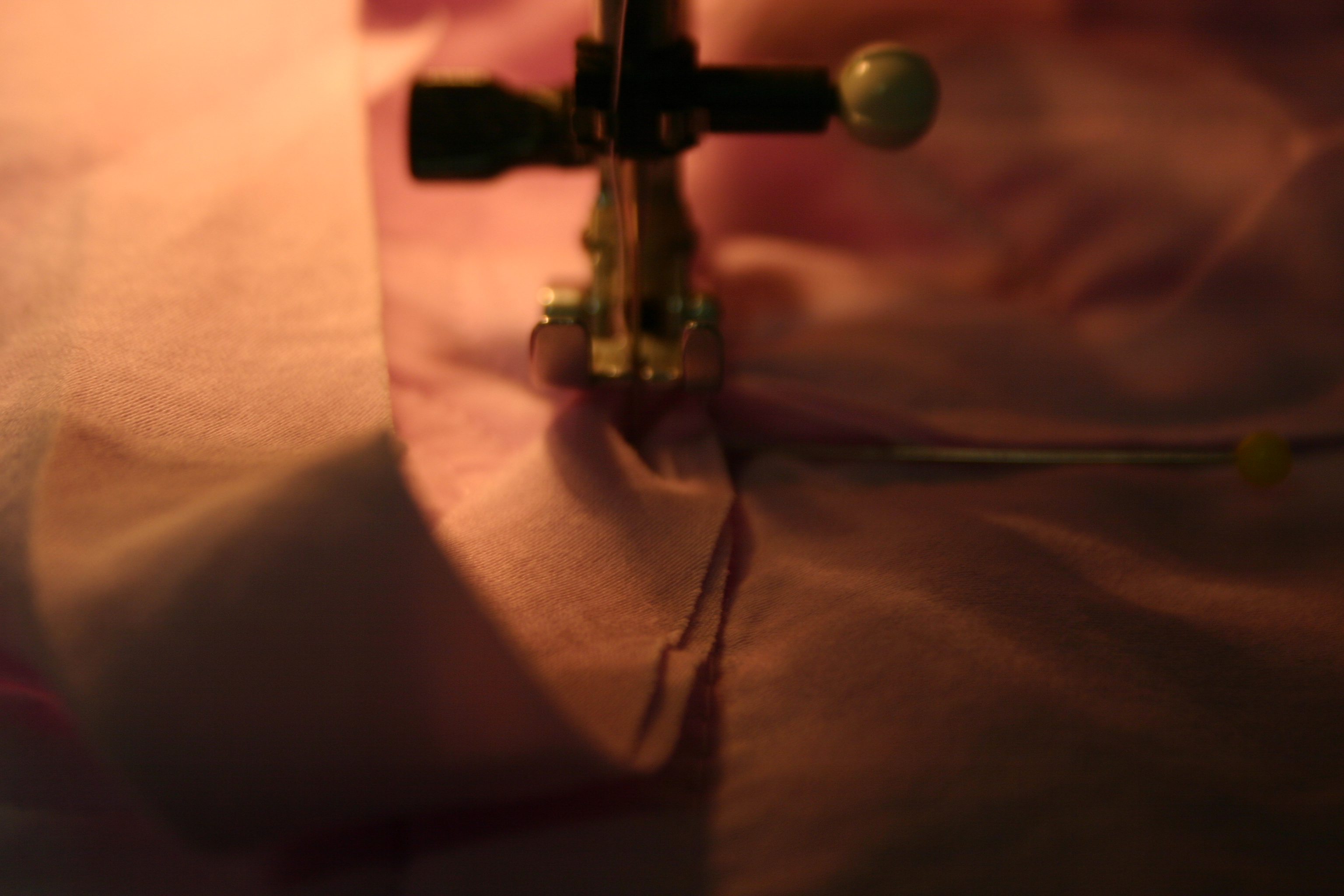
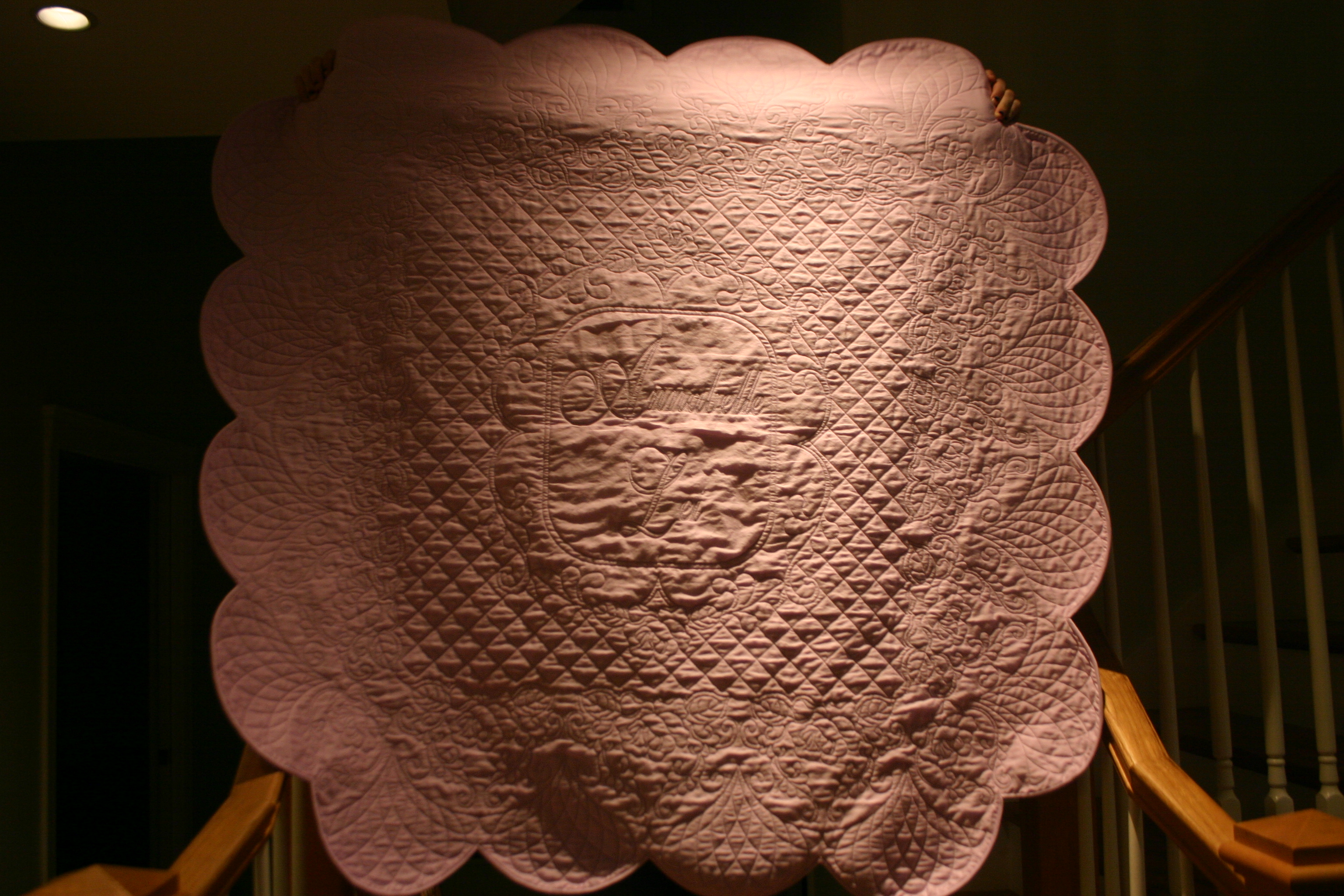
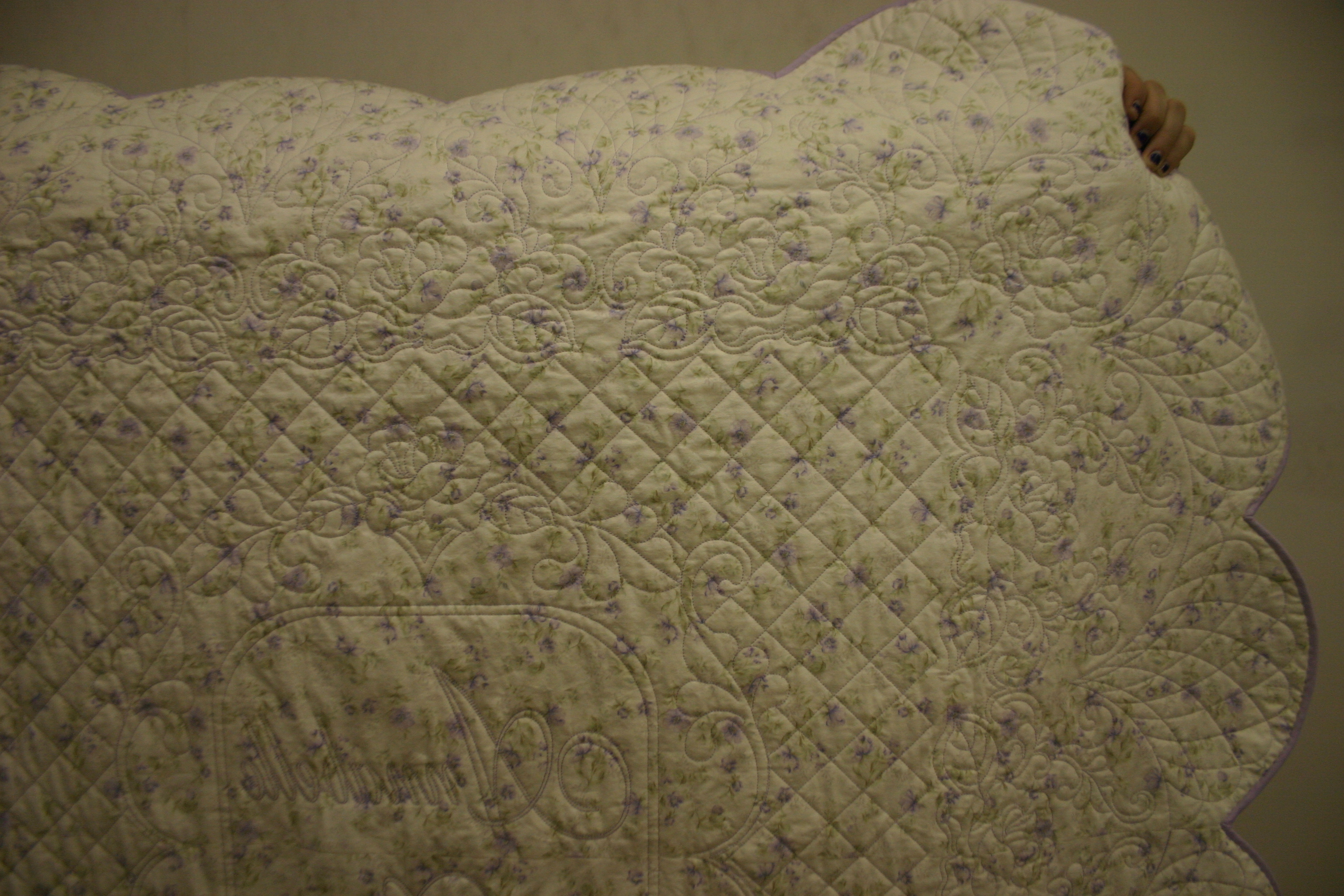
Here’s what you’ve been doing this month, what I’ve been working on and some of batting – good & bad:

This slideshow requires JavaScript.

Year End Quilting New

2012 is coming to a close!  Hummingbird Hollow Creation’s biggest highlight & achievement – my longarm machine is PAID in full!  In preparation knowing it would be paid off by the end of 2012 I decided to reward a customer each month during the upcoming year with $100 of quilting during 2013.

Here’s the list of winners!

January – Marianna Baier

February – Betty Wimmer

March – Dorothy Hinkes

April – Sandi King

May – Kasey Miller

June – Helen Graham

July – Lisa Hansen

August – Karen Darby

September – Dot Clear

October – Estalla Harris

November – Monike Moody

December – LeAnn Sholer

2012 Prolific Quilters!  Ties in all 3 places!

1st Place — Pam Brackett & Jackie Macuk for 11 quilts.  $20 off your first 2013 quilt!

2nd Place – Helen Graham & Barbara McVeigh for 9 quilts.  $15 off your first 2013 quilt!

3rd Place – Sandi King, Kathy Law, and Betty Wimmer for 6 quilts. $10 off your first 2013 quilt!

I’ve been asked in the past how many quilts I personally make – not as many as usual – but 3 very important ones for 3 new grandbabies!  And then another 11 for great nieces & nephews – still have another 4 to finish and even more to get started on!

2013 I have plans for two quilt just for me!  Both hand applique – I love the look!  One is a Block of the Month with Shabby Fabrics called Peppermint Place.  If you haven’t ran across them – they have some beautiful patterns & fabrics.   And the other was a Block of the Month with Honey Bee Fabrics  but I was late in signing up, so I purchased the pattern Baltimore Autumn quilt and will be scavenging for the fabrics in the coming months.

Here’s what you have all been doing the last few months!

This slideshow requires JavaScript.

Have a wonderful 2013!

Curved Bindings

There are plenty of blogs, how to, etc on the internet that give detail explanations on binding curves but I thought I’d share some things I learned while doing it on my newest grand daughter’s baby quilt.

So first thing DO NOT cut the curves.  I marked them and then basted all the layers together.

Bias binding is a must!  I made my own continuous bias binding – again plenty of blogs & how tos online.  I cut mine an inch and 3/4 wide and pressed it in half.  Other recommend single bias but I like to double mine.  I used the basting line as my guide placing the binding up to it and then stitching.

The tricky part is the inside corners – I stitched it 1/4 past the point before turning.

Leaving my needle down I turn the binding around the corner…

And continue sewing the binding down.  I did clip & trim the inside corners when I turned the binding to hand-stitch down.  If you use single bias binding you can probably avoid clipping the inside corners.  When hand-stitching the inside corners I found another quilter’s tips great.  Her site is – http://ankastreasures.wordpress.com/2012/02/17/a-tutorial-on-binding-scallops/

Here’s the finished quilt!

And here’s my granddaughter!  My husband made the cradle – I added bumper pads & flannel sheets.

Tips for Preparing Your Quilt for Longarm Quilting

First off – my apologies!  I really thought I could keep up with a once a month blog – so it may be a little less often.

This week I was asked to participate in a panel of longarmers for a local guild meeting.  We had a great time swapping stories & tips with the guild members.  It also provided a topic for the blog!

Preparing Your Quilt Top
✸    Press all seams – either to one side or apart, but well-pressed.  If you wanting stitch in the ditch in your quilt, be sure all the seams are pressed the same direction.  Pressing is best done while you quilt – although with the new fangle irons that turn off after a few minutes, it can be a real pain to wait for the iron to reheat all the time.  Pressing just makes things look good.
✸    Trim all threads – stray threads will show through light fabric.  Nothing more frustrating for me when I see a dark thread between the batting & the quilt top – especially after I’ve quilted it.  I try to catch them but some still manage to slip through.  Thank heavens for really tiny crochet hooks!
✸    Stay stitch a scant 1/4″ around outside edges to keep seams from popping and to stabilize bias edges.  A few clients serge the edges – some longarmers say no – I say it’s your quilt top.  I will add that serging might stretch the edges of your quilt but so can sewing a straight stitch if you pull the fabric instead of guiding it.
✸    Square your quilt top.  It there is a problem with the top, there may be a problem with how the quilting design lays on the quilt.   For allovers – this isn’t a big issue unless the design is real square – then it might look odd at the top & bottom borders.
✸    Uneven piecing, puckers & wavy border will NOT quilt out.  You will have tucks & extra poof in spots – I do what I can to ease it all together, but I can only do so much.
✸    If you are planning curved corners, wait until longarm quilting completed to cut – I cannot quilt with backings cut with curves, so just wait.
✸    Press your quilt top,  fold neatly and then hang on the hanger in your quilt bag I return your previous quilt in!  One – you save $2 when you re-use the quilt bag and two – it keeps everything together, nice & neat.
✸    If there is a top edge, mark with a safety pin or note.

Backing
✸    Backing fabric should be same color value as quilt top.  As a rule, the top thread & bobbin thread will be the same color. Light thread on dark fabric will have too much contrast and dark bobbin thread can sometimes peek through to light colored quilt tops.
✸    For best results use 100% cotton for backing – but there are lots of options.  I’m pretty game for most anything, as long as it is not too stretchy.
✸    Please do not use sheets – skipped stitches and other irregularities will occur.  This is due to the higher thread count in sheeting.  The needle does not slip through the weave but rips it.
✸    If your quilt top fabric has been pre-washed, pre-wash the backing fabric also.
✸    Remove selvages from backing fabric before seaming.  The selvages are a tighter weave and so when you piece a backing and don’t remove the selvage – it can cause sagging between the sides & seam – which can result in tucks in your backing.
✸    Backings need to be at least 4″ to 6″ larger on ALL sides of the quilt.   I’ve allowed less  – but prefer not.  The backing is attached to the machine top & bottom with pins – lots of them.  And the sides – industrial sized clamps.  If there isn’t a buffer of space for me – it can result in broken needles or worse a bent needle bar on my machine.
✸    Square backing – not an easy task with large pieces of fabric. I’m really okay with doing it for you – but please allow extra fabric beyond the 4-6 inches. Generally squaring up a piece of fabric can result in a loss of several inches if it was cut lopsided at the fabric store.
✸    Press all seams open.
✸    If your backing is pieced, stay stitch the backing a scant 1/4″ on all sides – again your preference, I don’t require it.
✸    Press and fold neatly – see above.
✸    If there is a top edge, mark with a safety pin.
✸    If the backing is seamed, note if you want the seam vertical or horizontal.  Most longarmers prefer vertical – I’m game either way.  I will generally try to maximize the amount of extra fabric to add back to your stashes.

Batting
✸    Dream or Hobbs battings are recommended by most longarm quilters.  Some battings do not work well on the longarm quilting machines. Battings that pull apart easily, shred, or bunch are difficult to use.  Cheap battings can cause irregularities in thread tension throughout the quilt.  You don’t see it but your batting can make or break how well the quilt looks afterwards – it’s worth the extra money to purchase better battings.
✸    Battings need to be at least 6″ to 8″ larger on ALL sides of the quilt.  It is preferred that the quilt sandwich is balanced in thickness from side to side – so that as I roll it the sides don’t start drooping
✸    Piecing batting – its up to you.  It will cause bulk in spots if you overlap or zigzag.  The best methods are 1) purchase quilt batting tape.  I use Heat Press – I love it! 2) Over lap the pieces you are joining, cut down the center, throw away the waste, the edges should match, and then hand whip stitch.  Time-consuming.

Thread

✸ Lots of choices!!!  Do you want 100% cotton in your quilts?  Do you want to the quilting to show or blend? I’m always glad to give advise or suggestions on what would look best on your quilt.

Designs

✸Lots of choices!!!!!!!!!!!!!!!!  Plug for myself – I do designs.  They are sold to other longarmers through quiltrecipes.com.  Of course I’m free to use them for my customers whenever I feel prompted to do so.  There are lots of designers out there – many have lots & lots of designs, but not necessarily good designs.   What I look for in a design is one that repeats well in a single row as well as multiple rows; that the stitching is balanced – no big empty space with lots of quilting in other spaces and one that gives the impression of having no beginning or ending.  I love when customers give me carte blanche and I can make your quilt projects come alive with the design or enhance & support your beautiful piecing.
Miscellaneous
✸    Please do NOT pin or baste quilt layers together.   Please leave them separated as they go on the machine, one at a time.

Well I think I covered most everything!  But you’re always welcome to ask questions or better yet add some of your own tips!

Happy Quilting!!!

Helen

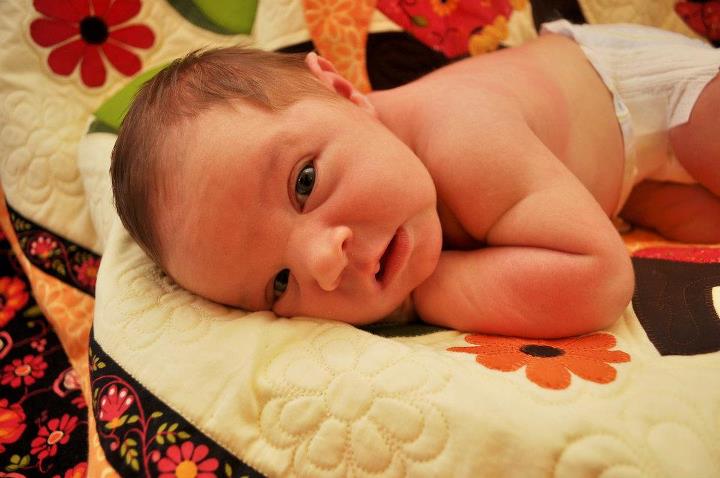
Grandbaby #5 – Penelope arrived the end of May!

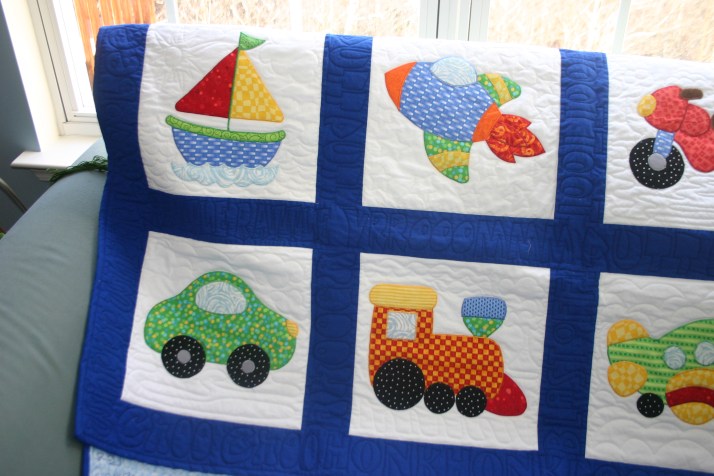
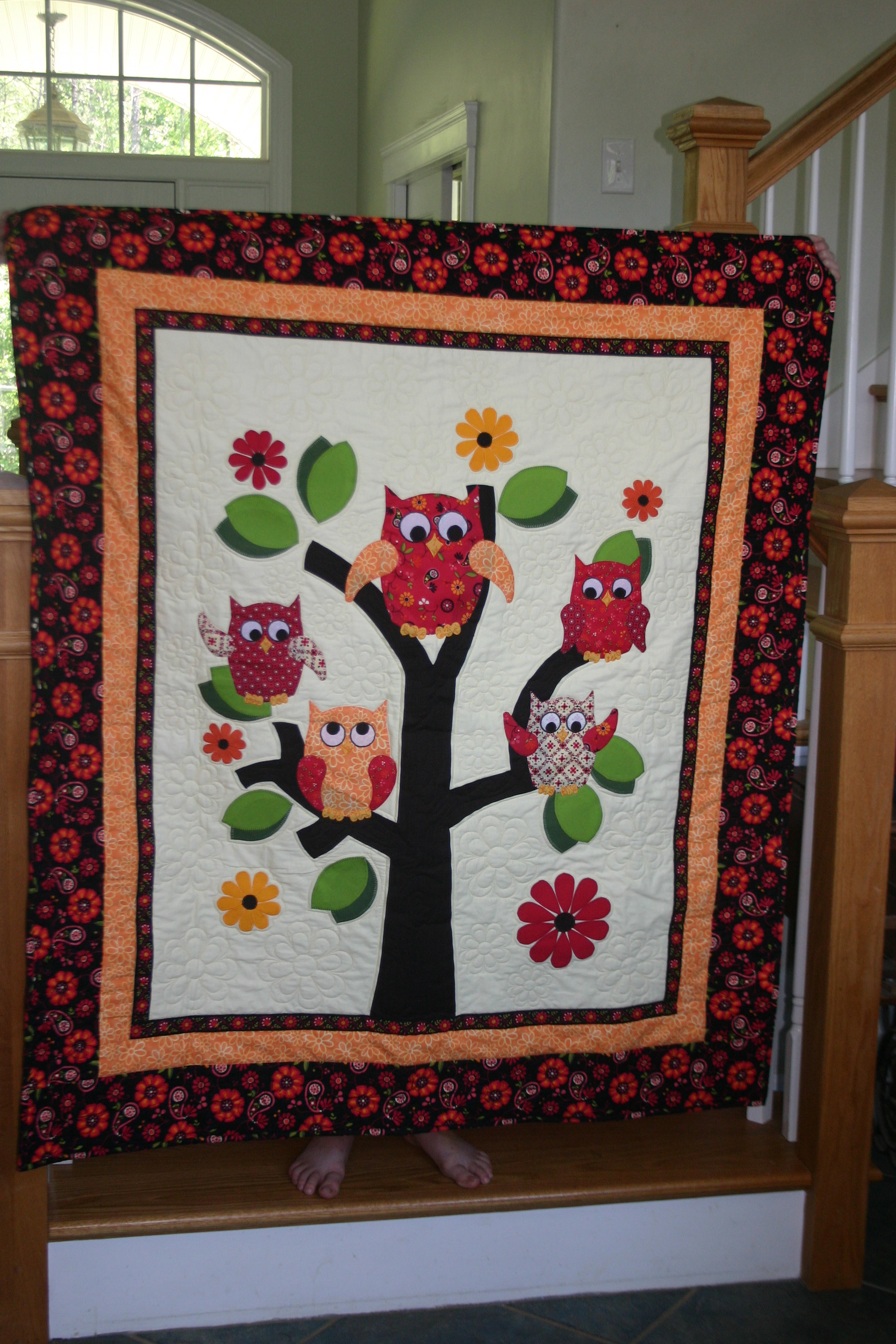
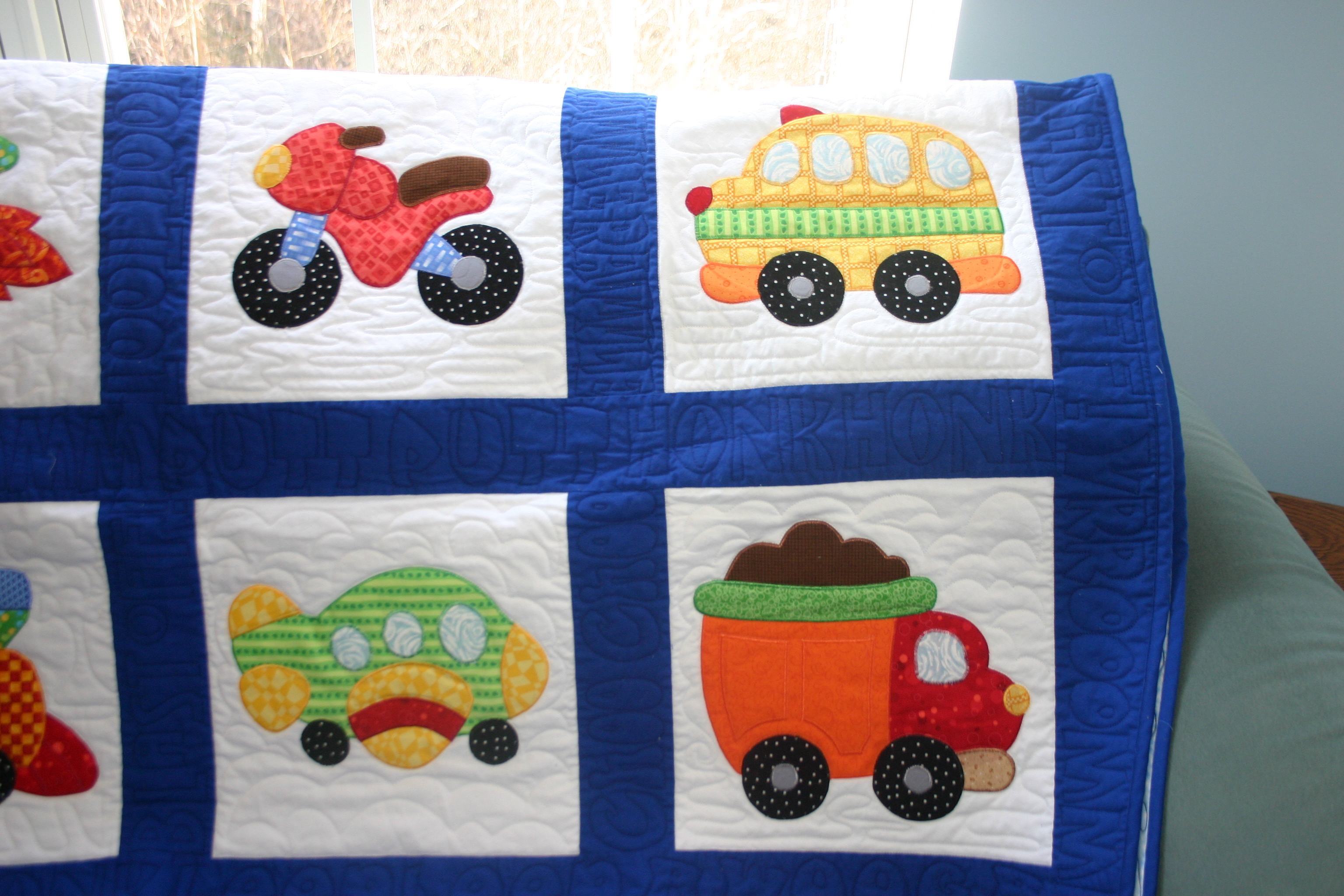
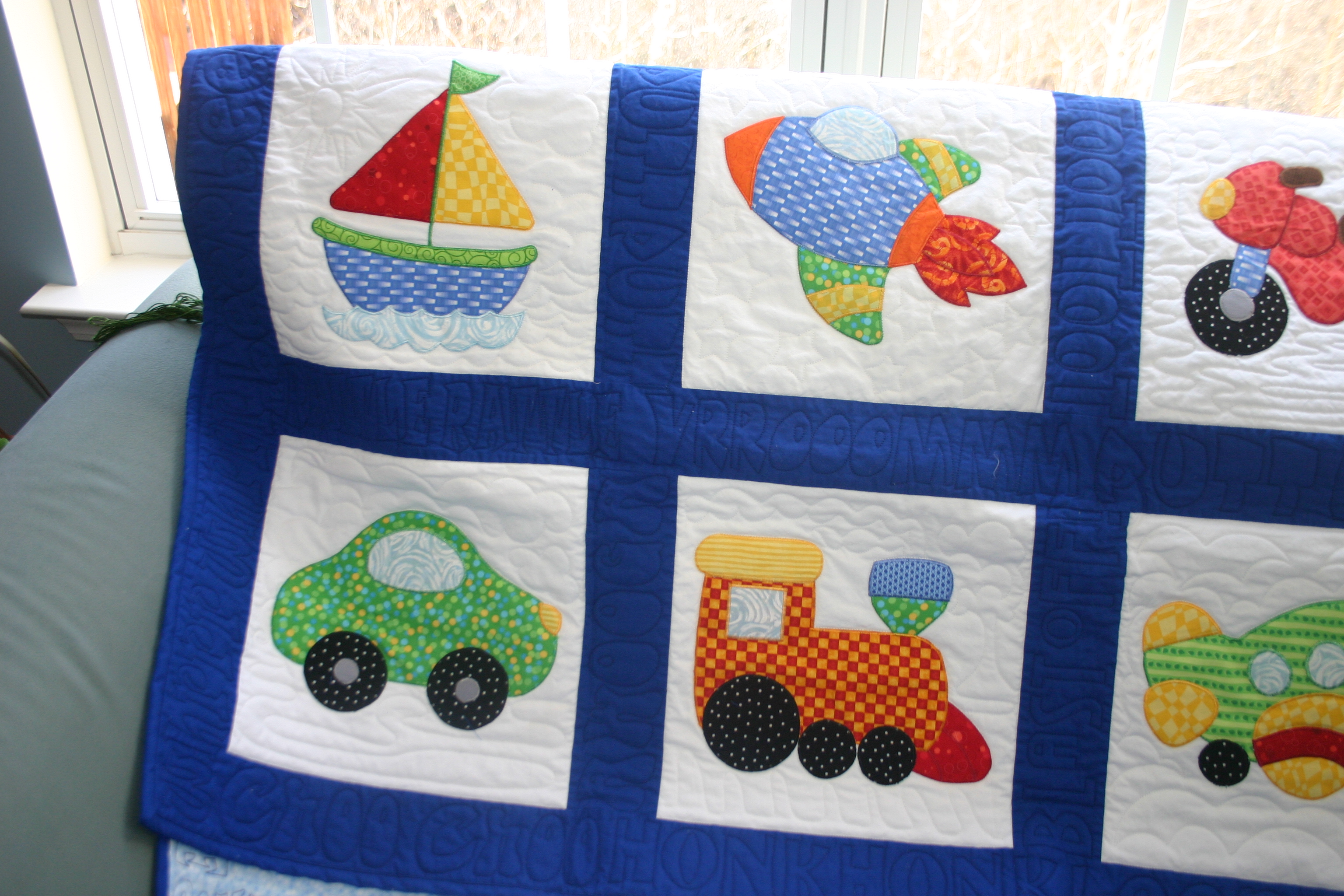
Penelope’s quilt! I had fun designing, appliqueing & quilting!

Applique!

First – I don’t know all the tricks!  But I have learned a few over the years and even this time around!

Patterns – you can find plenty of patterns for applique quilts out there but sometimes it is fun to do your own – anyone can!  A great place to start as a beginner is with coloring books – find one that has simple straight forward drawings.  Trace onto scrap paper – you can simplify more or move a line or add a curve.   Add color – with pencils or crayons or even scraps of fabrics you plan to use.  Decide on the order – start at the bottom and work up – you don’t want to do the eyes first!  And then we start…

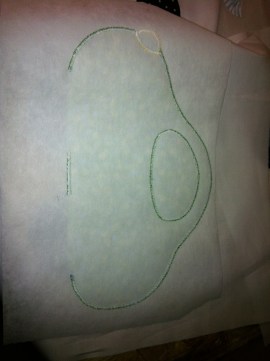
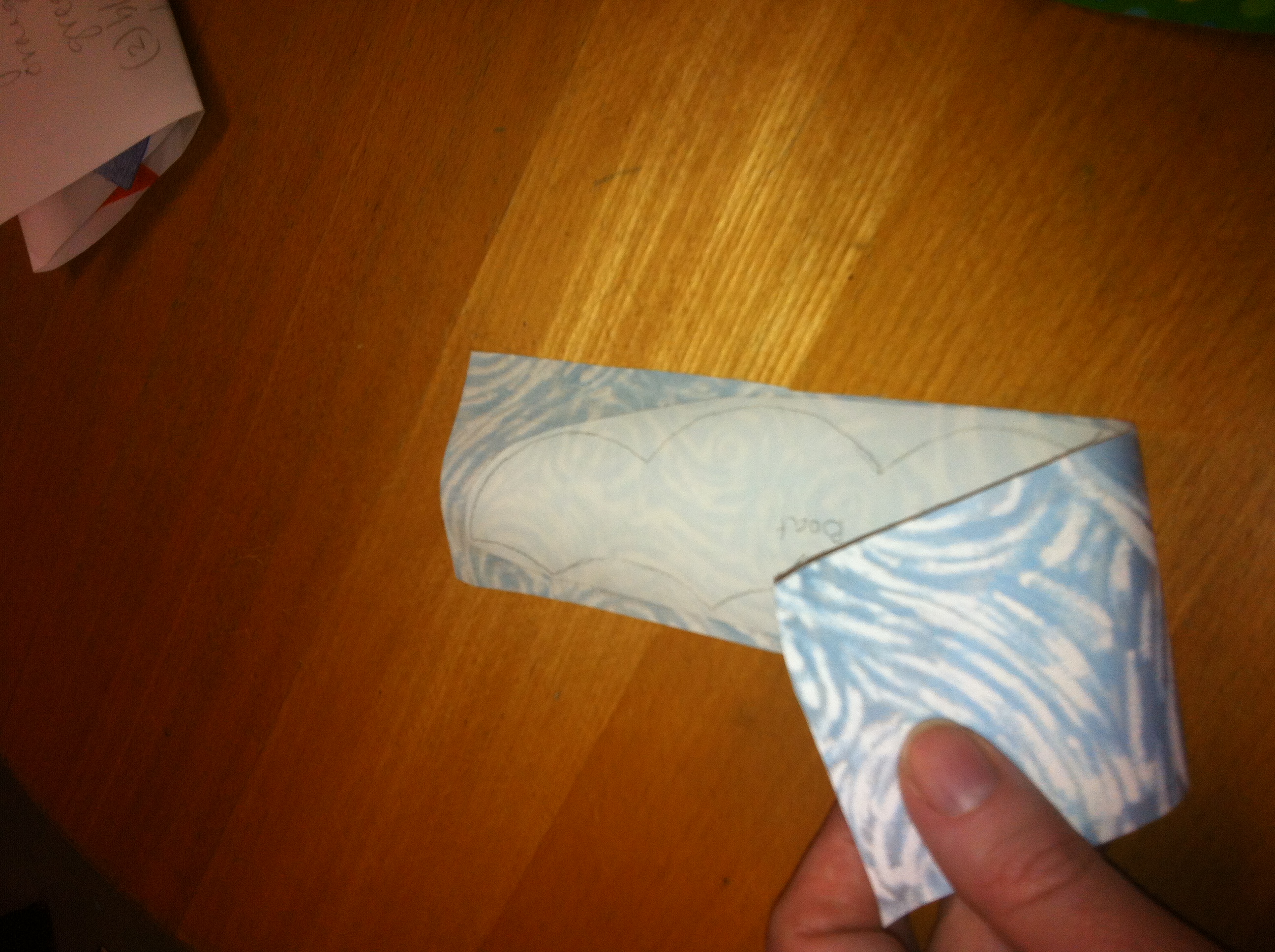
One of my favorite products for quilting applique is Heat Bond Lite. Your going to trace each shape onto the Heat Bond paper side.  Couple of things to remember:

1 – Reverse your shape, especially letters.

2 – Trace some extra fabric/heat bond to areas that overlap another fabric shape  – like a seam allowance, but only where there is overlap – you’ll see later on why this is important.

3 – Cut out the heat bond larger than the traced shape.

Next simply iron the  Heat Bond to the back of your fabric piece.  And then trim to the traced design – remember  not to trim the extra allowance of the overlap areas.
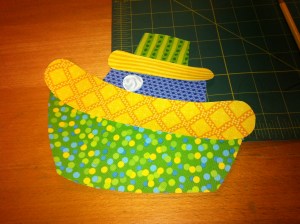
Do this for each piece of your design   – don’t it look great!

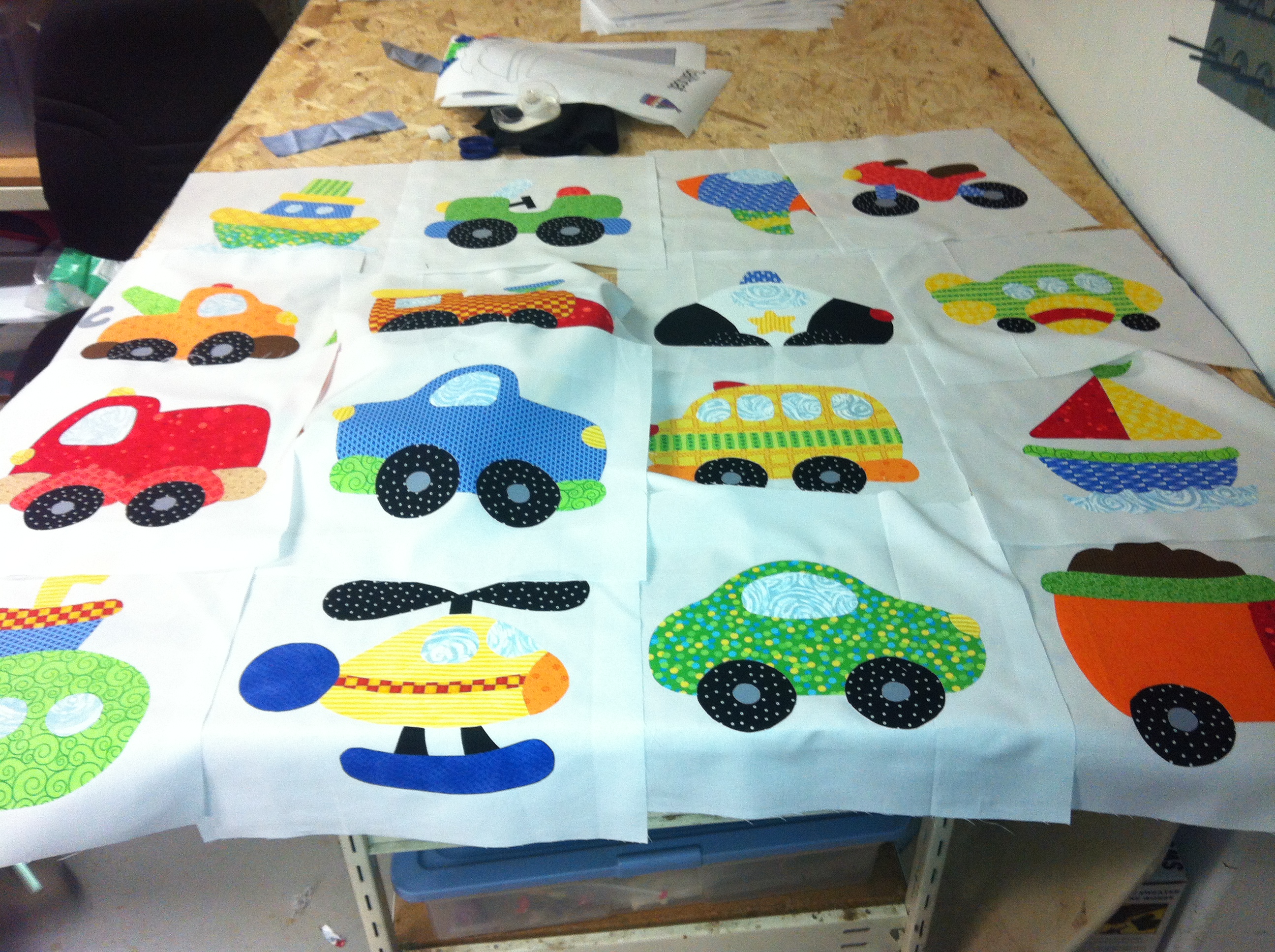
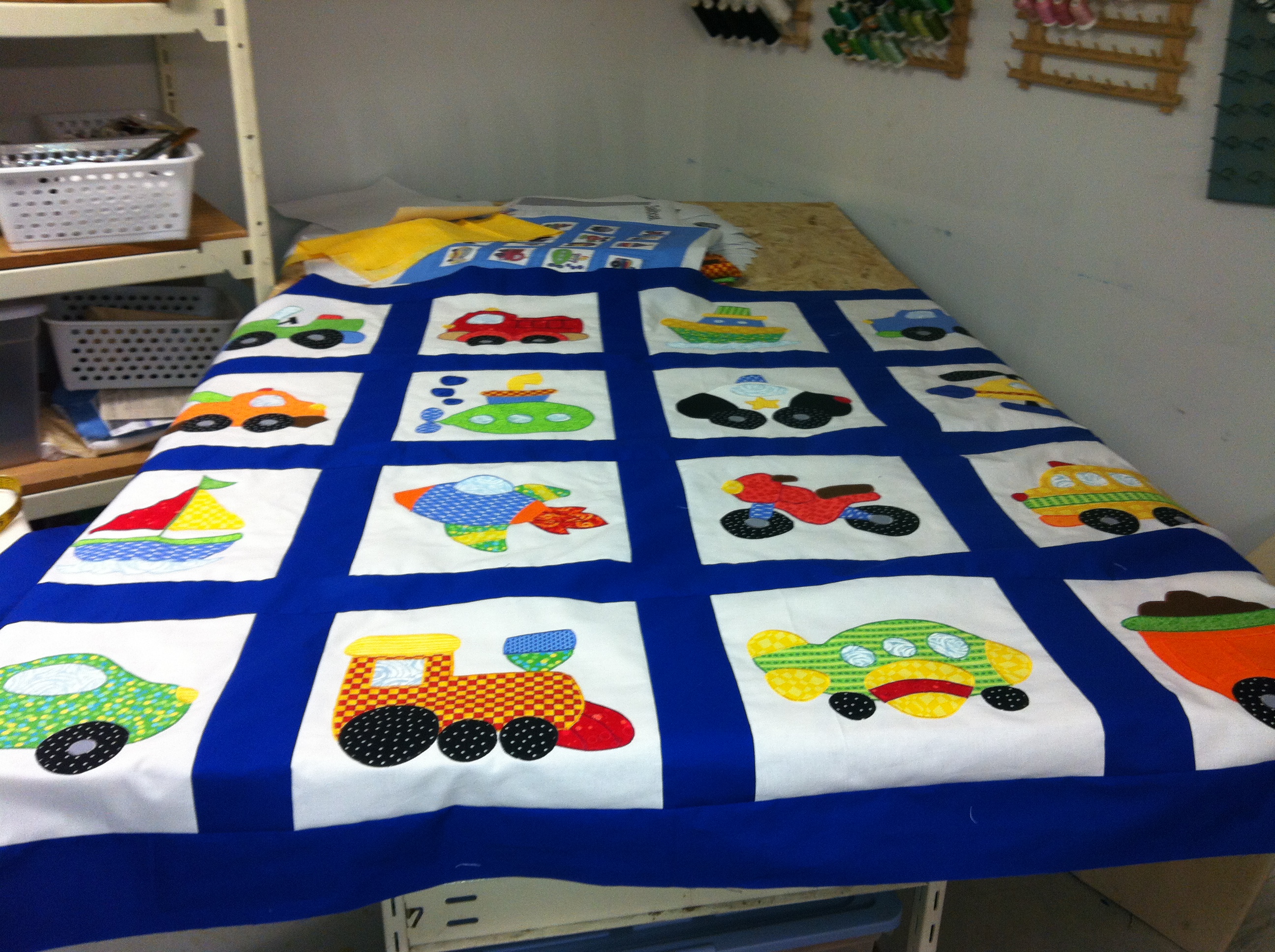
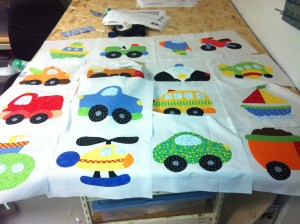
Now for my grandson’s quilt – I had 16 blocks to design, trace, cut out, bond, cut out again and layout!.  Quite an endeavor but it looked great at the end.

Now you’ll need to decide on a background for your applique – in a block? A quilt border?  Throughout  the quilt top?  Unless it is scattered throughout the quilt top – best to apply the applique to the quilt piece before putting the pieces together.  I like to cut my blocks about a 1/2-inch larger and then re-square them up after applying the applique just in case the applique has altered the shape.
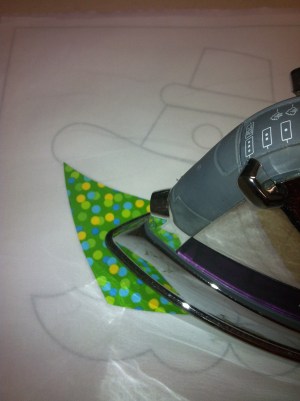
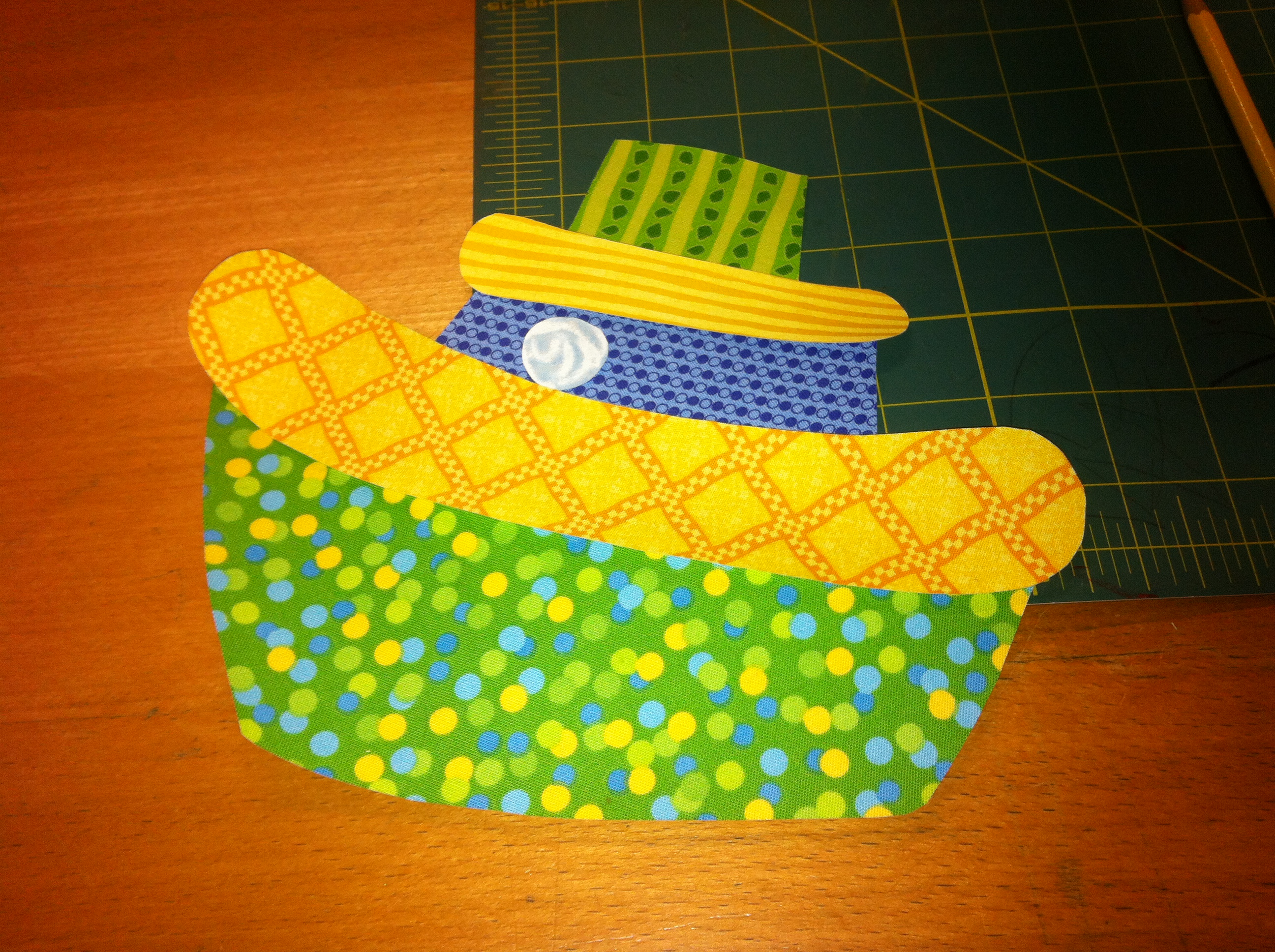
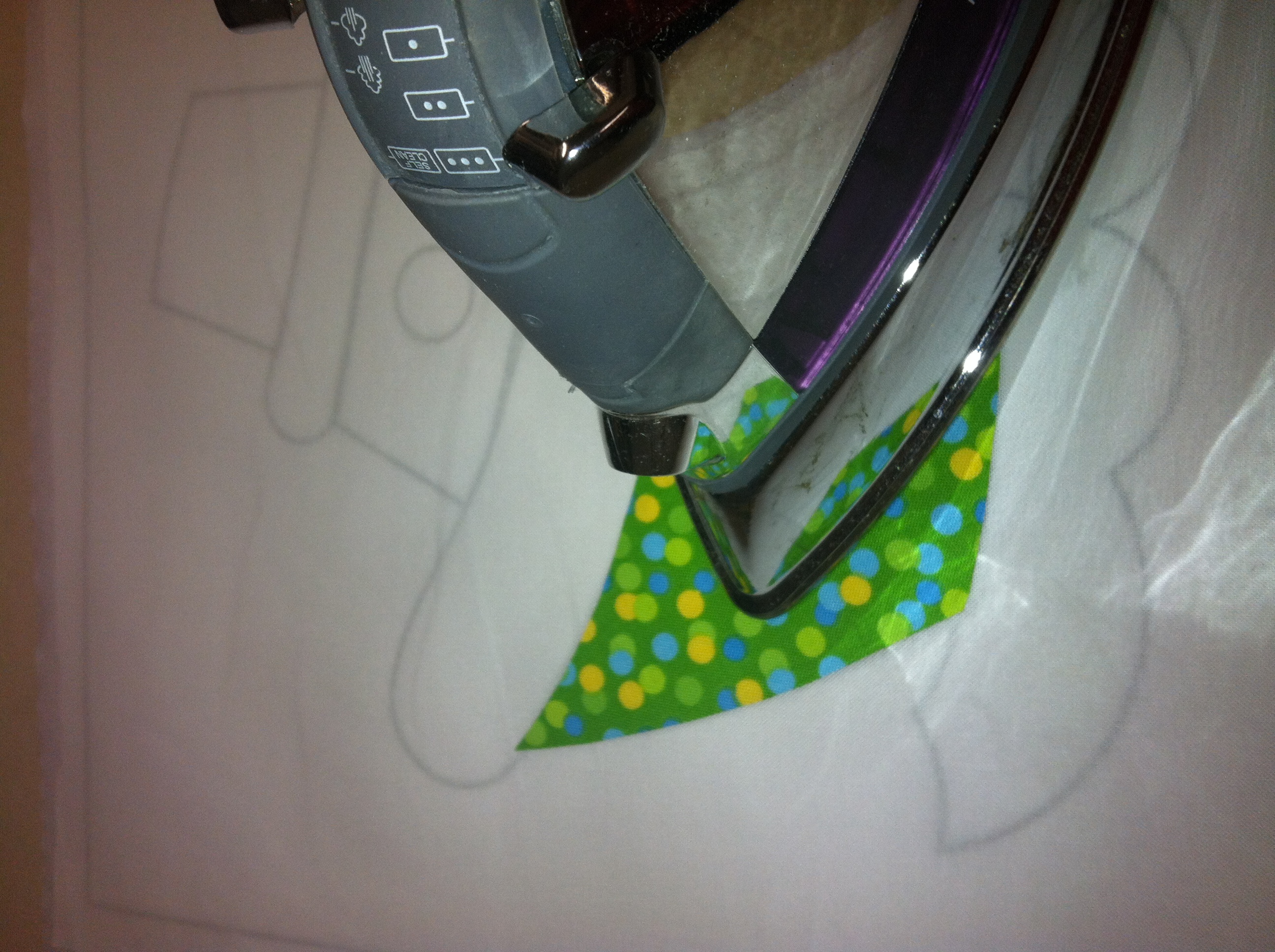
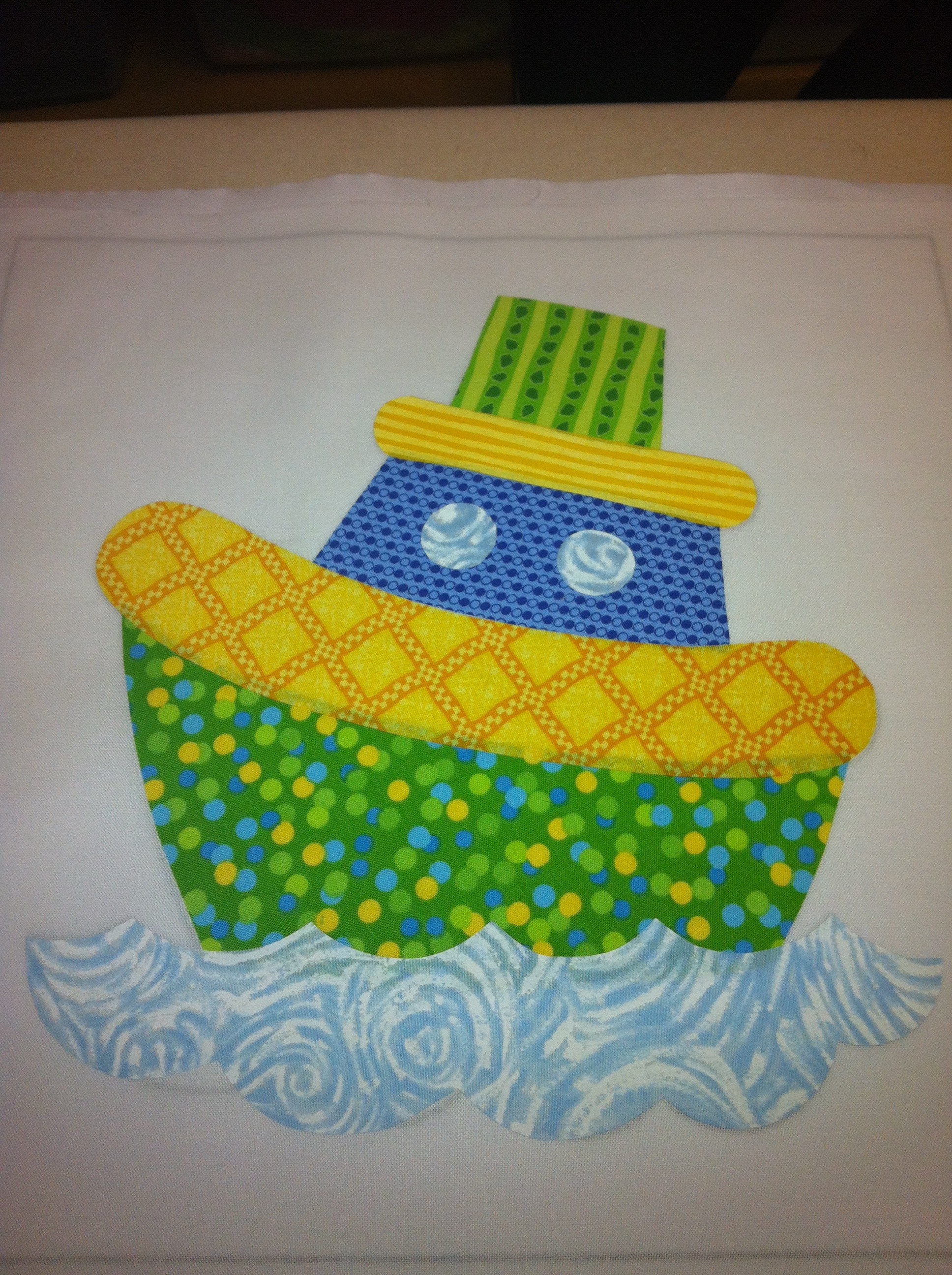
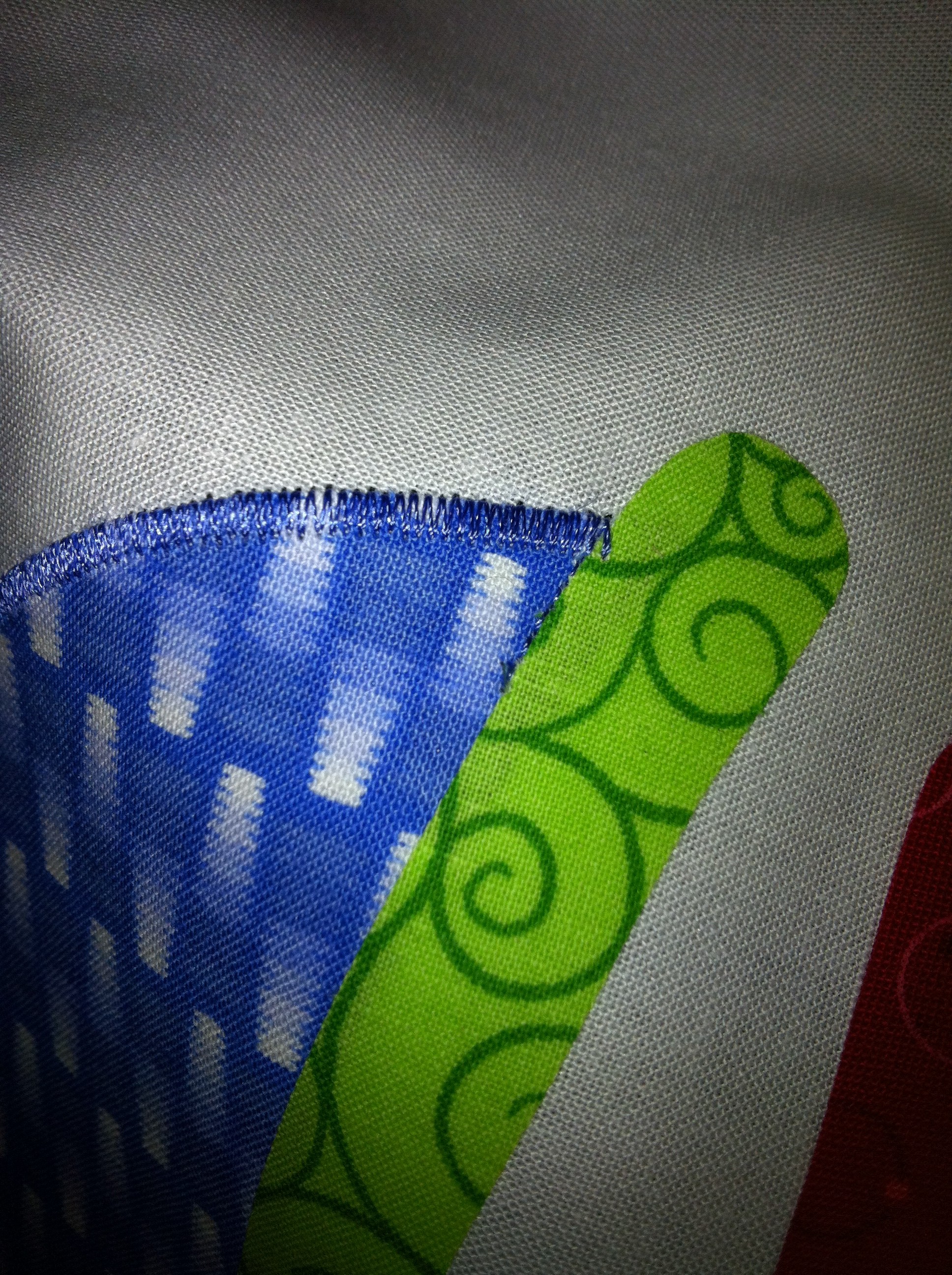
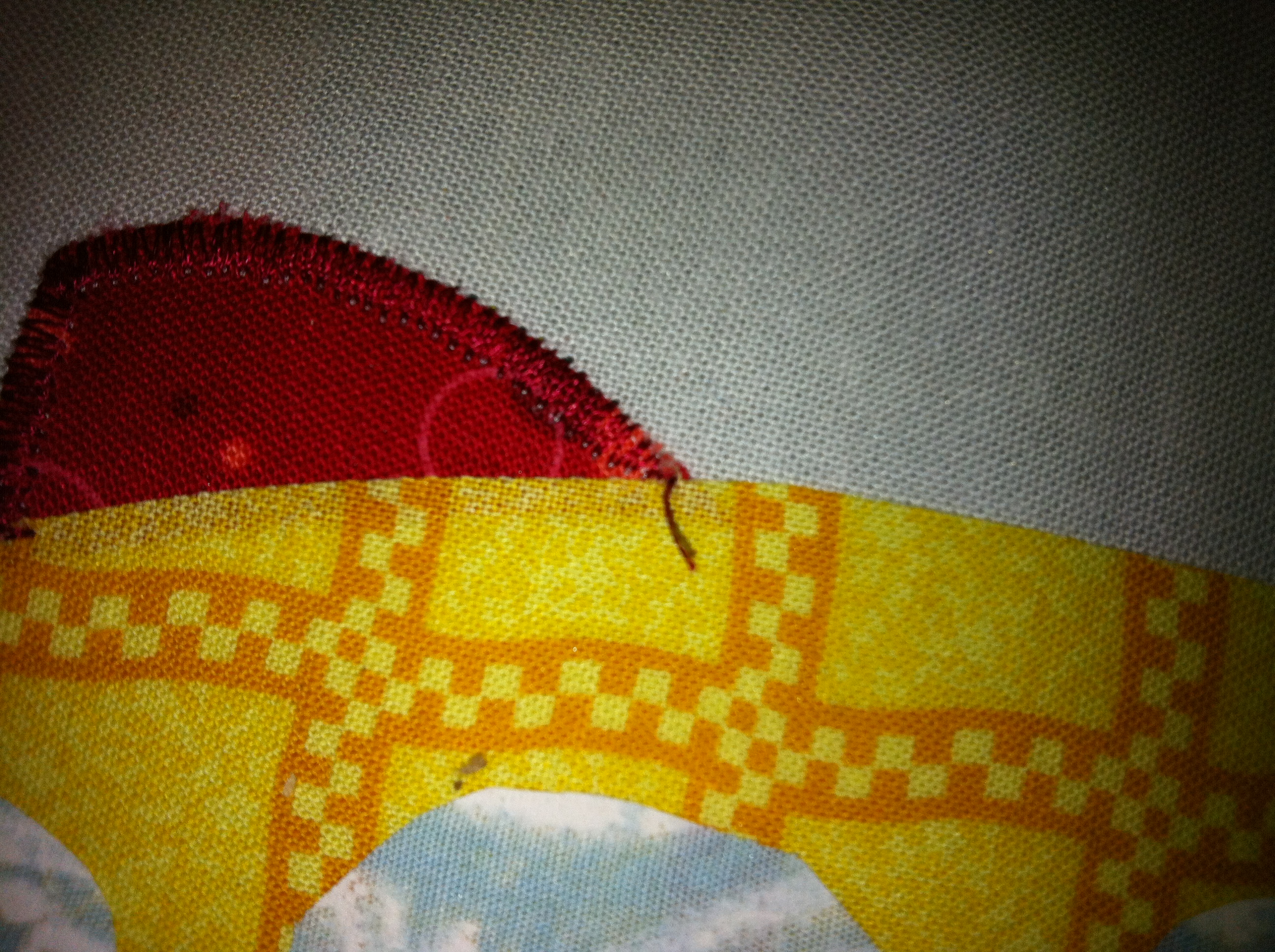
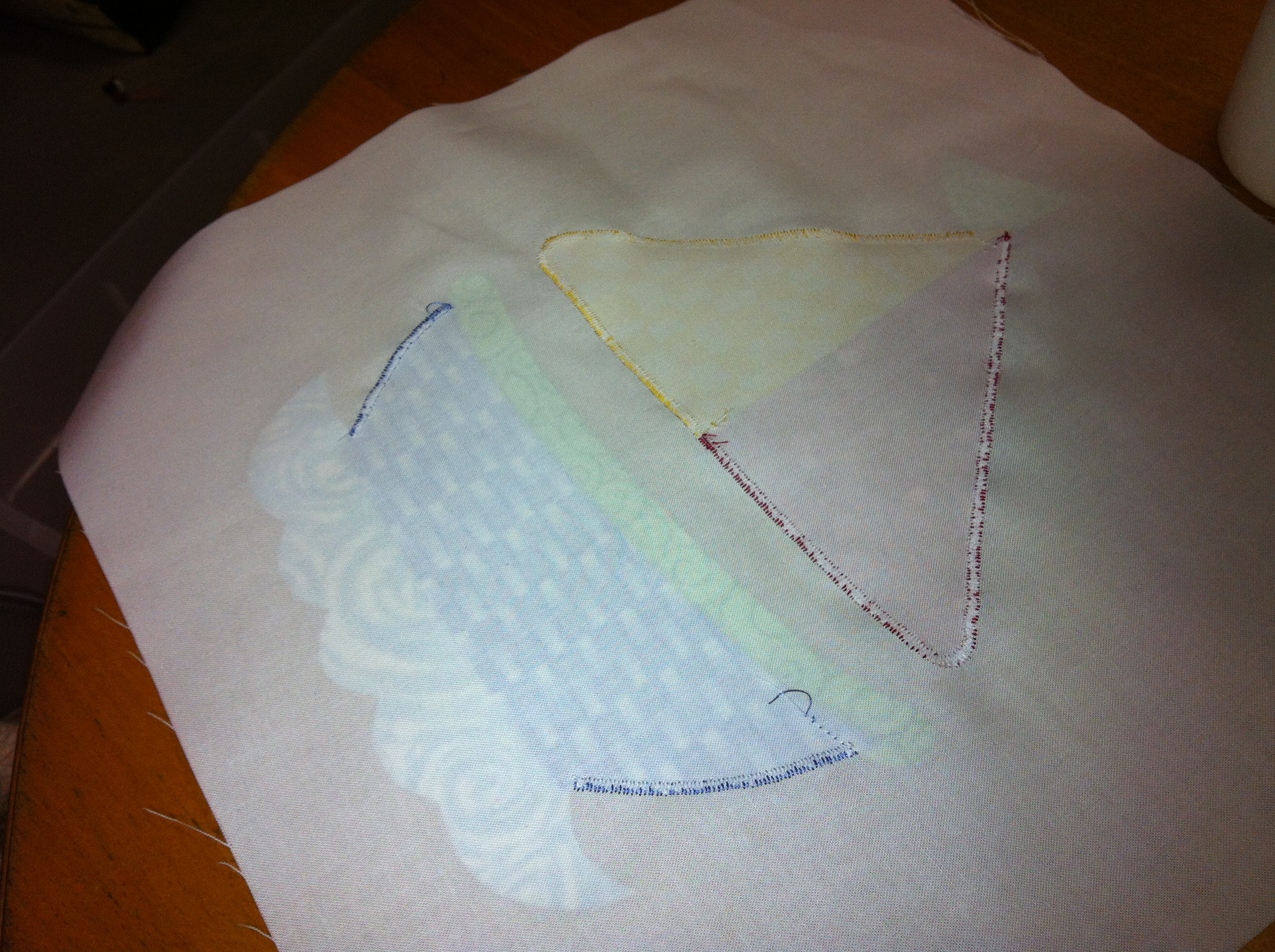
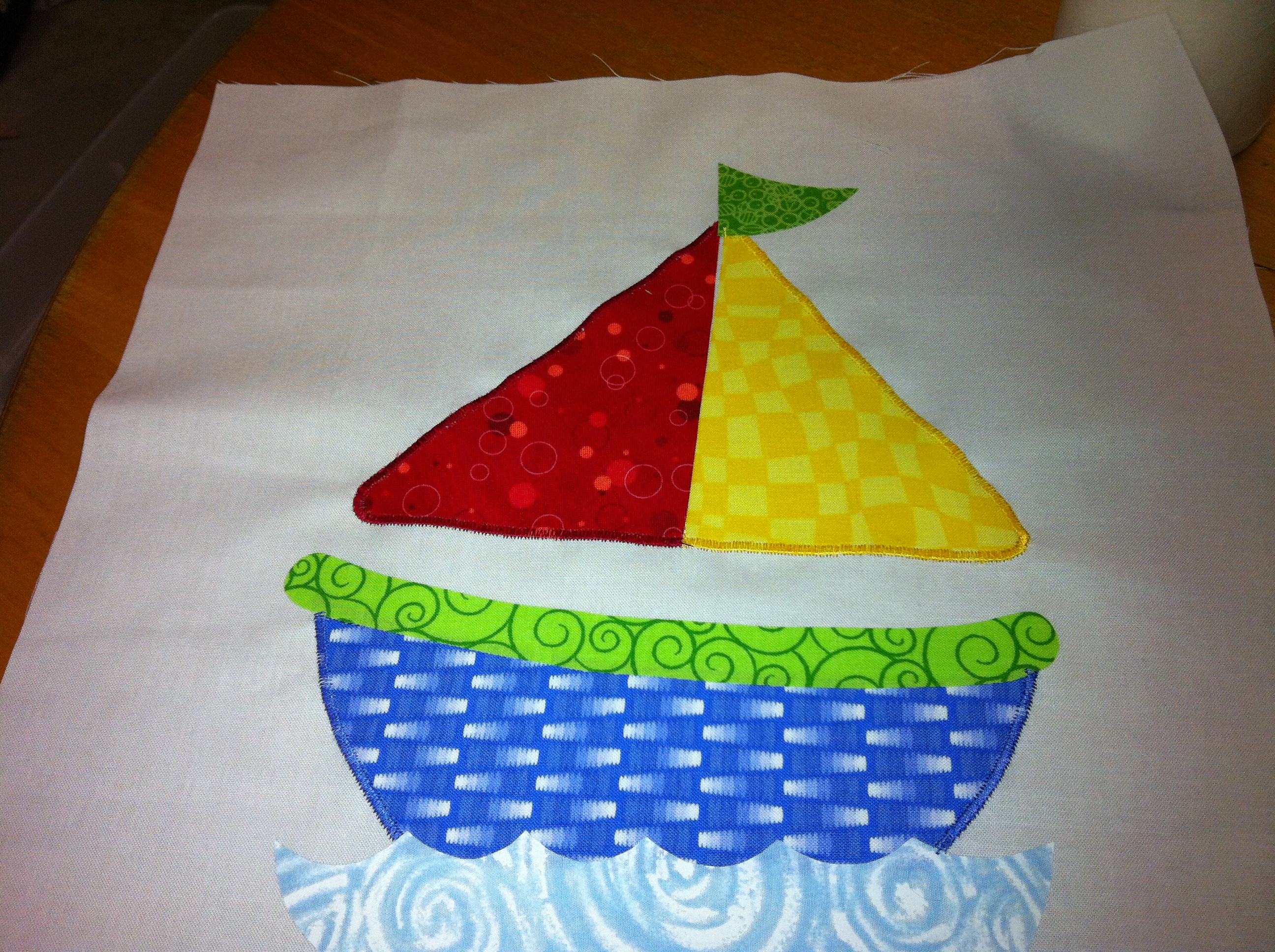
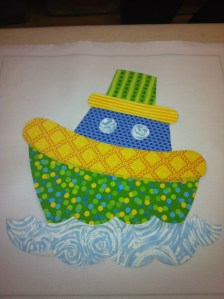
Because I chose a white background it was easy to put the original drawing behind the block to help in the placement of the pieces.  Note the extra allowance of fabric at the edge of the fabric.  Start with the piece that is on the bottom – here it is the hull of the ship. I was able to go ahead and iron on two more pieces that didn’t overlap.  Then I added the other three pieces – now here’s where I forgot to add some extra for overlap – note how the pieces are flush with the  lines of the pieces that go on top.  Not good – when it comes time to stitching the pieces there is no fabric underneath the top piece to catch in the stitching.  Whoops!

You can see in the below photo that there is some overlap with the hull of the ship and the top piece on it as well as the water. Whew!  But not so much with the other two.
All the blocks are ready!
Time to sew!

Now in the past when I did applique before Heat Bond  – I would have added a 1/4-inch to seam allowance to each piece, straight stitch the perimeter at the 1/4-inch seam line. trim closely to stitching and then stitch again with a zigzag stitch  – at your desired width & stitch length.

Now with the Heat Bond – I simply just go straight to the zigzag.

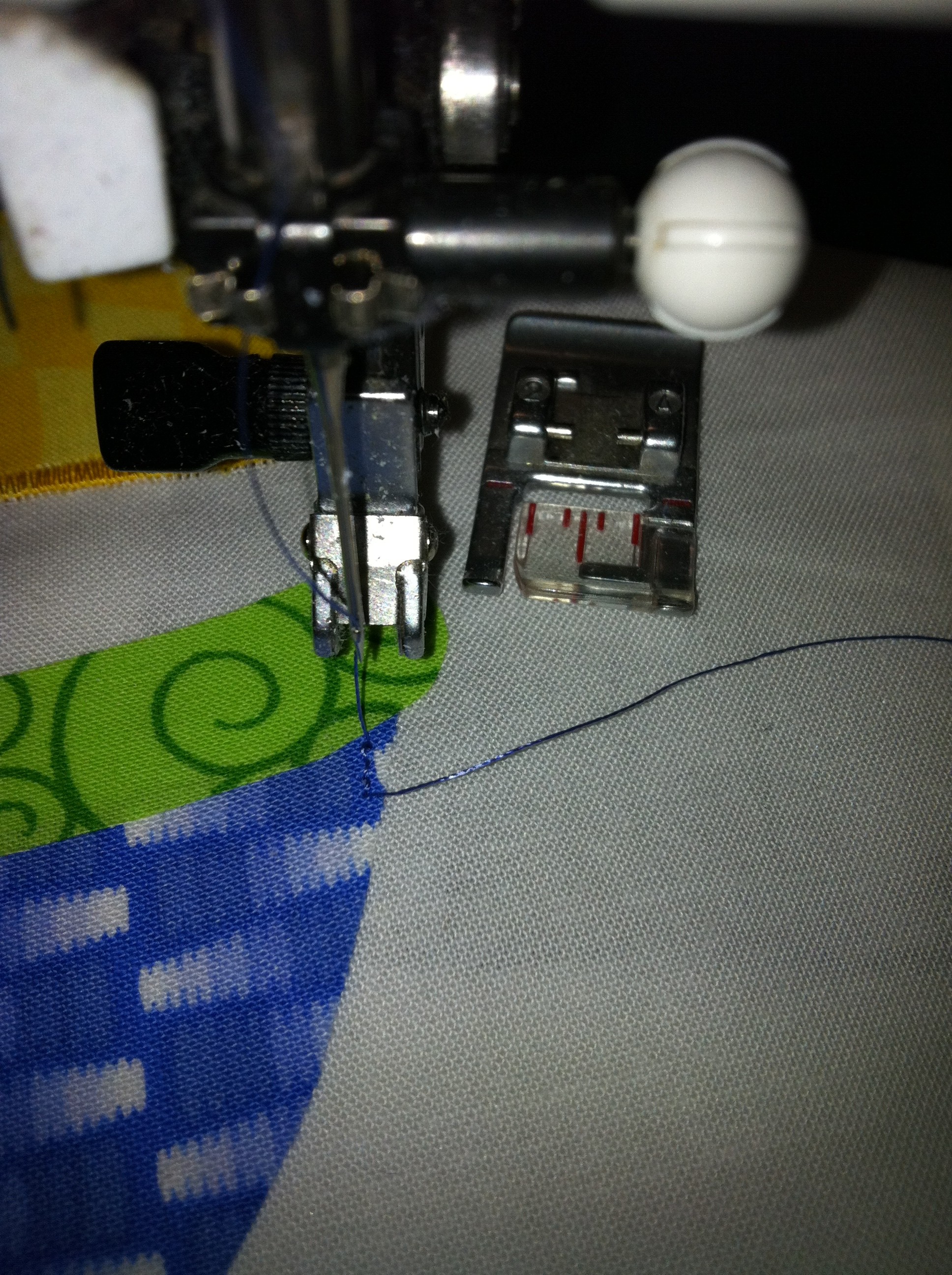
Again we start at the bottom and work upward.  To minimize thread changes I would do all the same color that was on the bottom or stand alone on all the blocks and then move onto the next color.  I begin & end with tiny straight stitches to lock in the stitching  – zigzag is notorious for coming out.
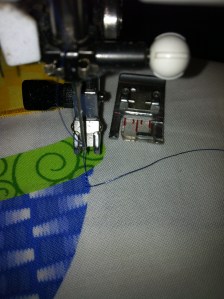
Ending can be done either directly on the zigzag or down the edge where it will be hidden by subsequent zigzag.

Another option for ending – needs a bit more patience – but is great for tips of leaves – anything that has less than a 90 degree angle.  You simply decrease the zigzag width while stitching – or decrease, sew a couple of stitches, decrease, sew a couple of stitches… like I said requires patience.
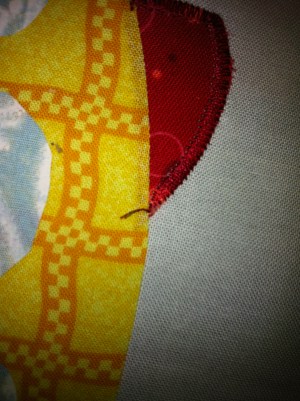
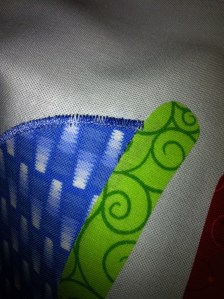
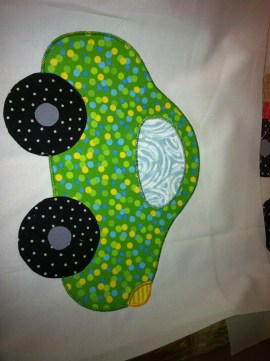
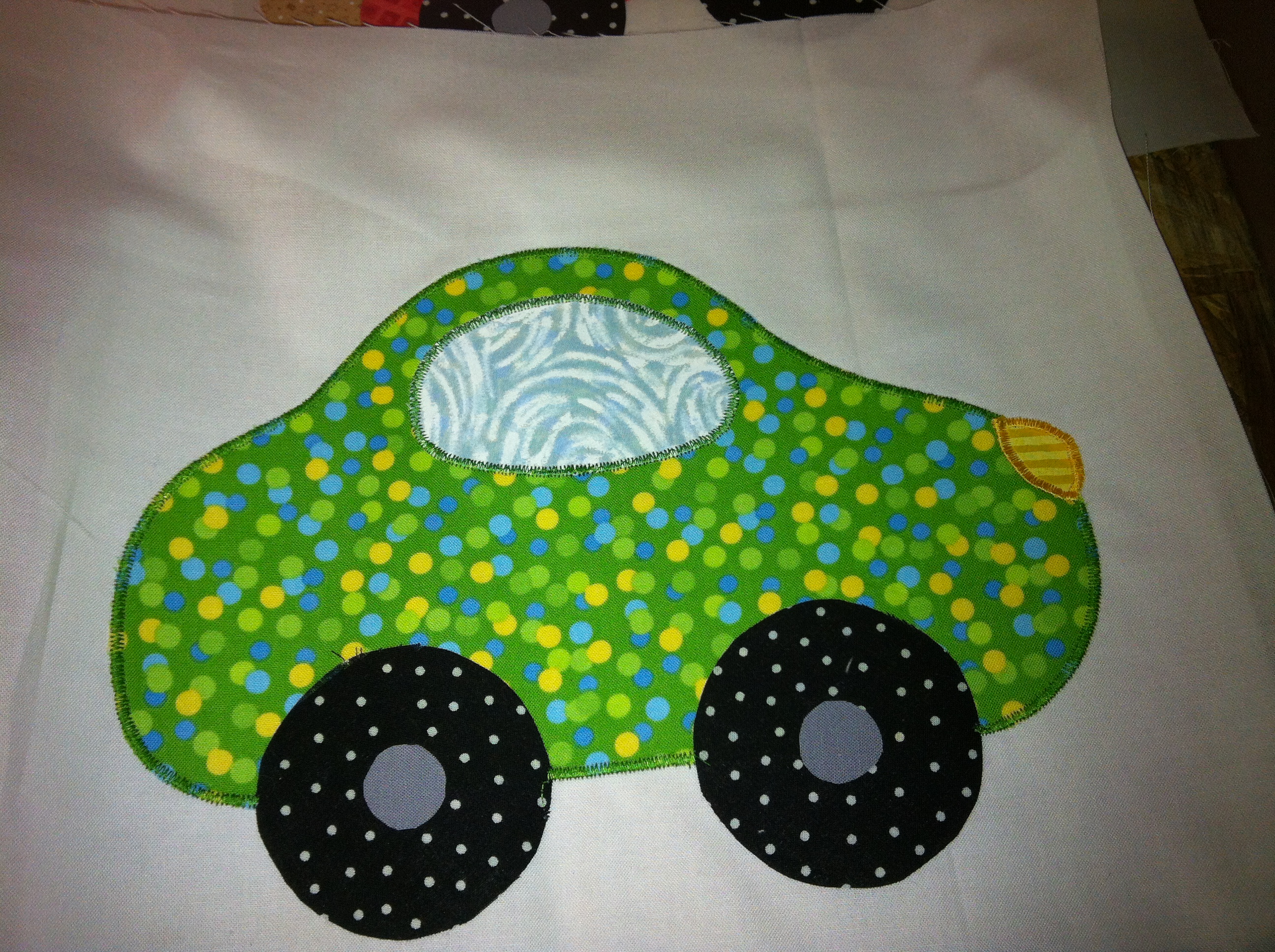
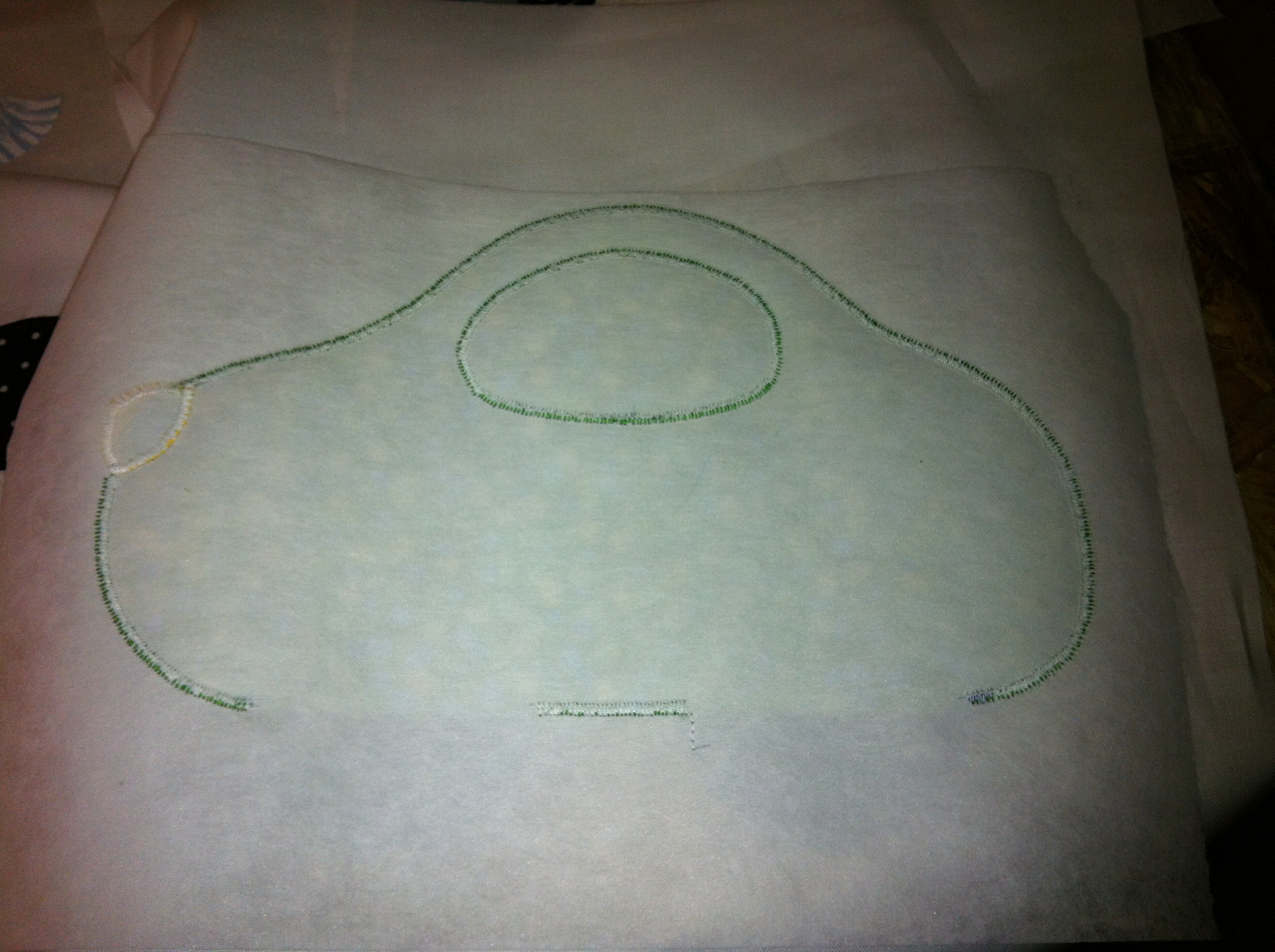
Using  additional stabilizer – a good idea!  I used a light weight tear-away type – when I remembered!  You can see how the one sailboat is not as smooth as the car.
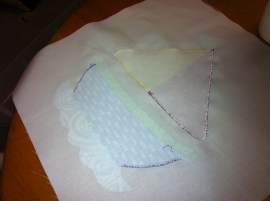
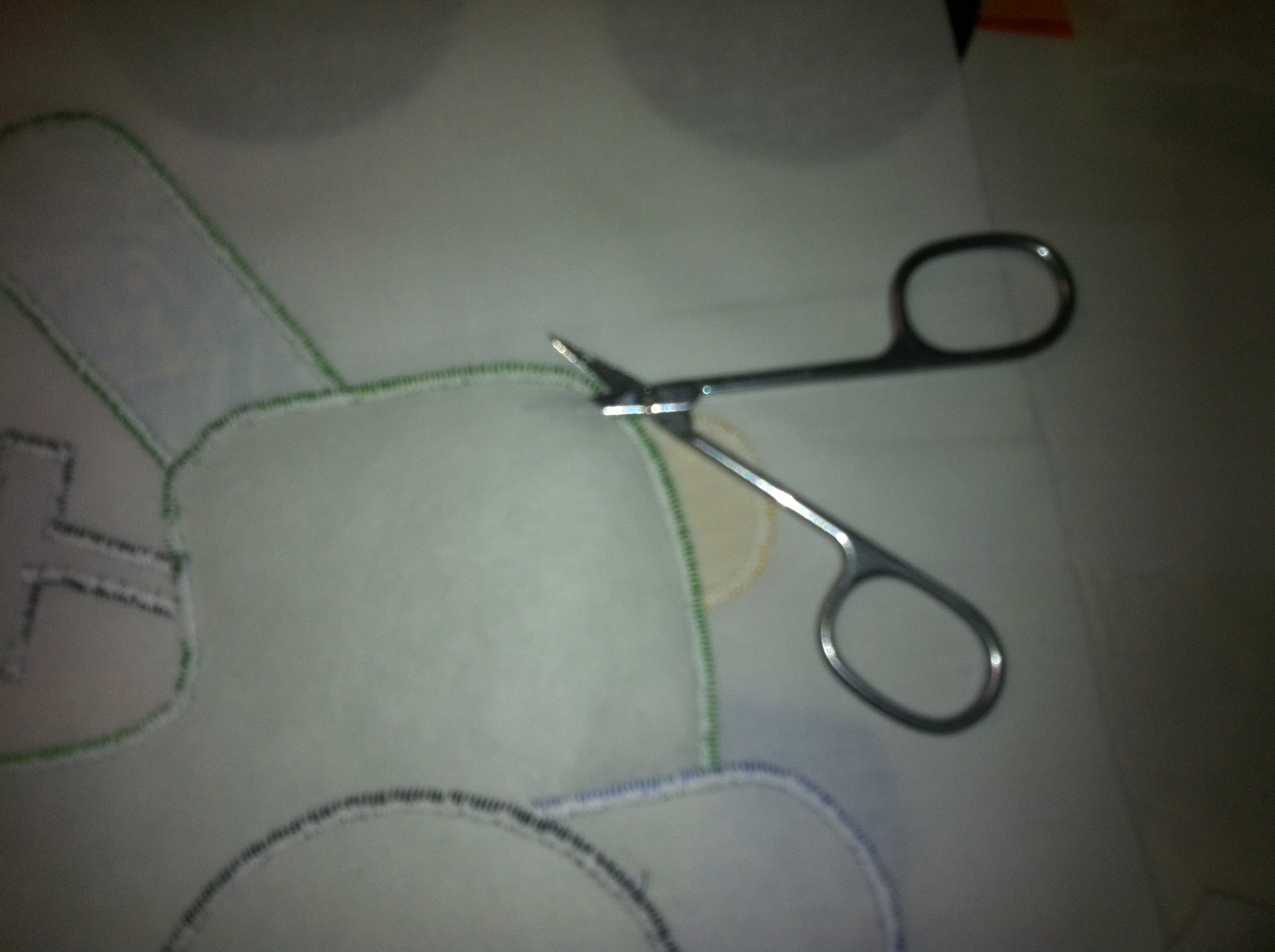
You can simply tear it or use small scissors to trim it away on the insides.  Cuticle scissors are a great little tool to have near the sewing machine!

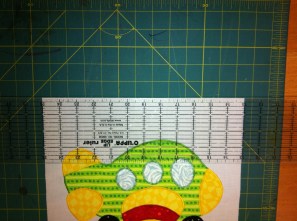
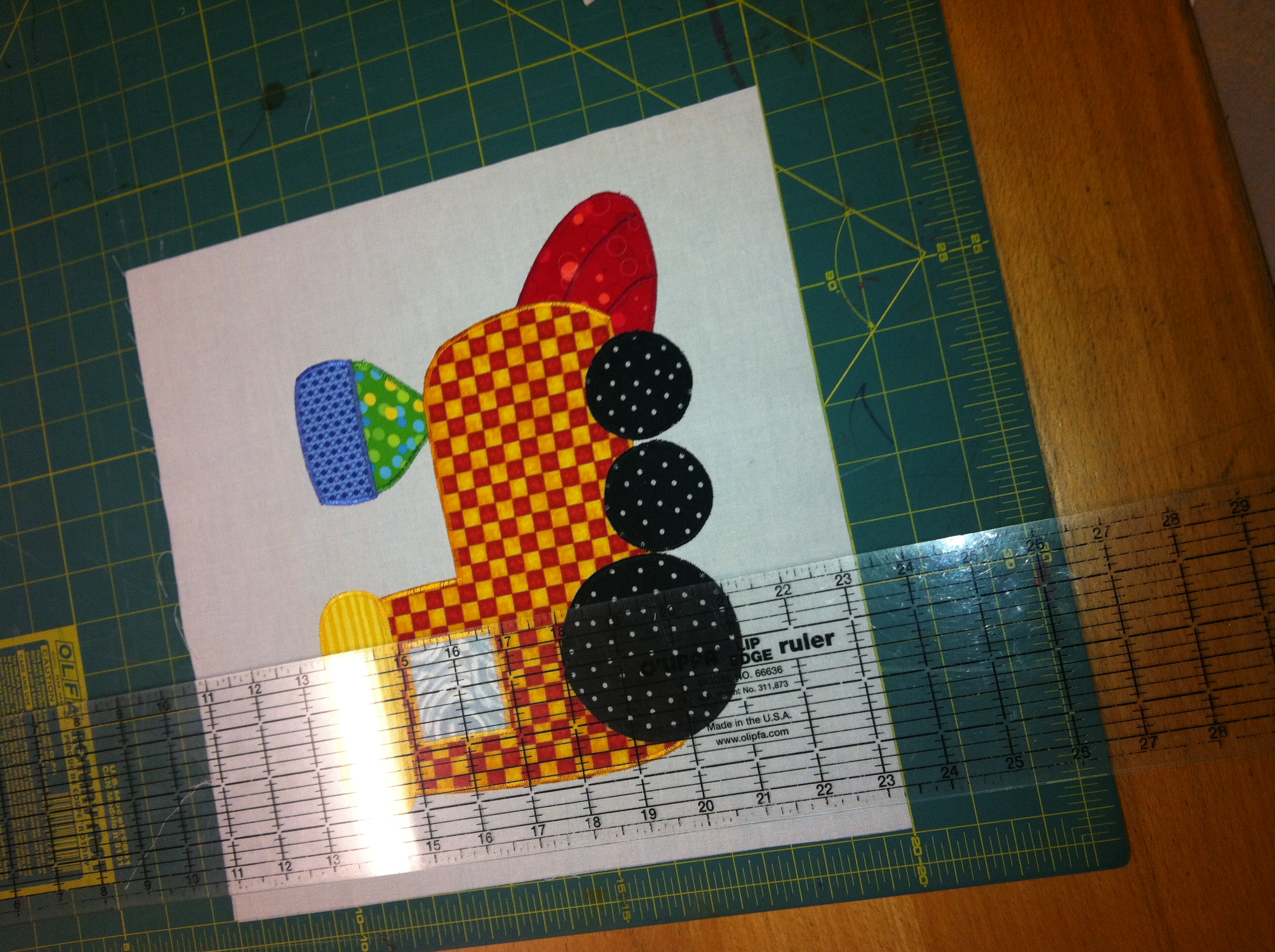
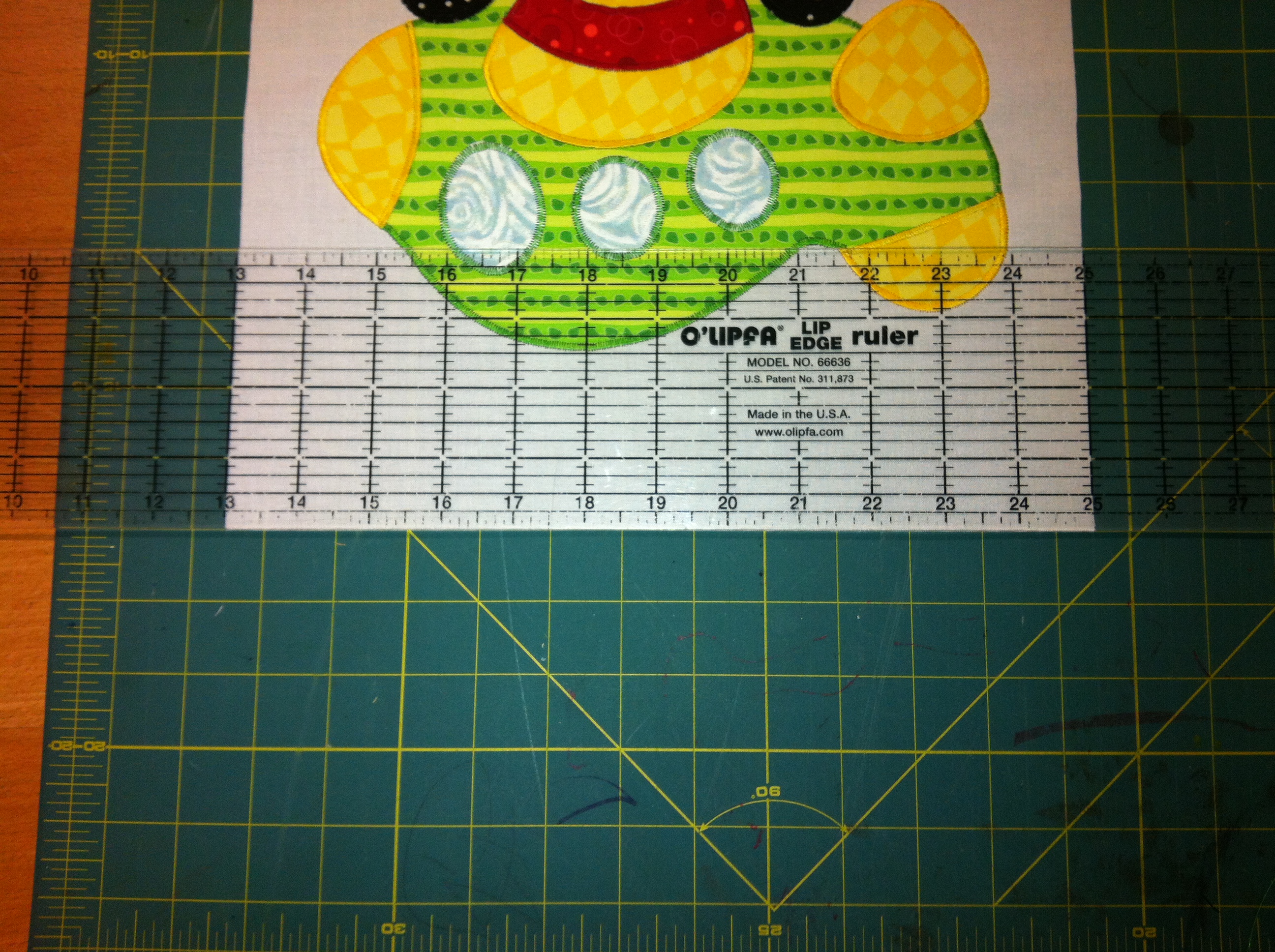
Time to square up!  Fairly easy if you cut your background a bit larger than planned.  Use a grid & ruler to check your design is center and begin on one edge.  Using the first edge as your guide for the other cuts.
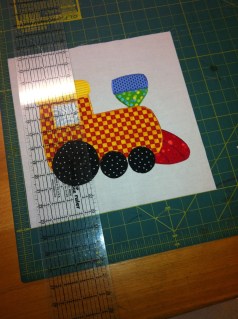
Now it’s time to put your quilt together!  Have fun!  Feel free to share any tips you’ve learned doing applique with the rest of us!

My newest grandson’s quilt – ready to quilt!
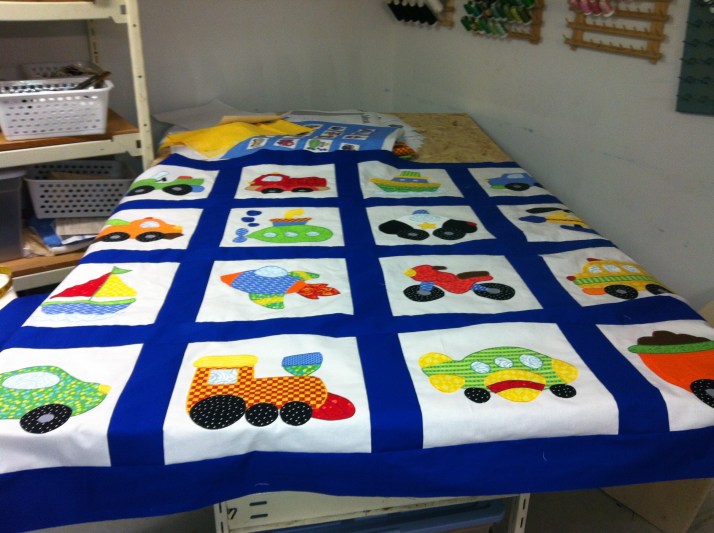
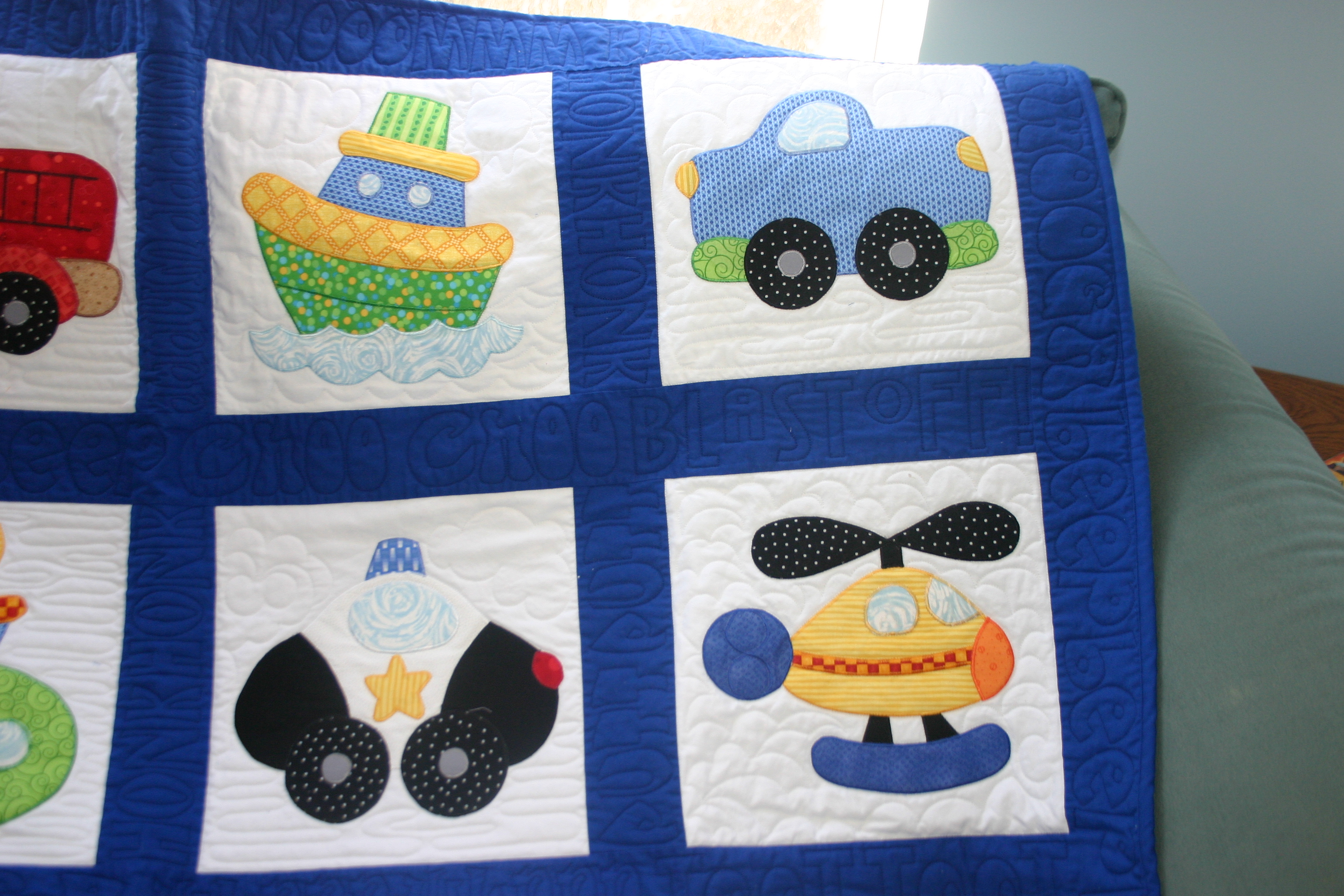
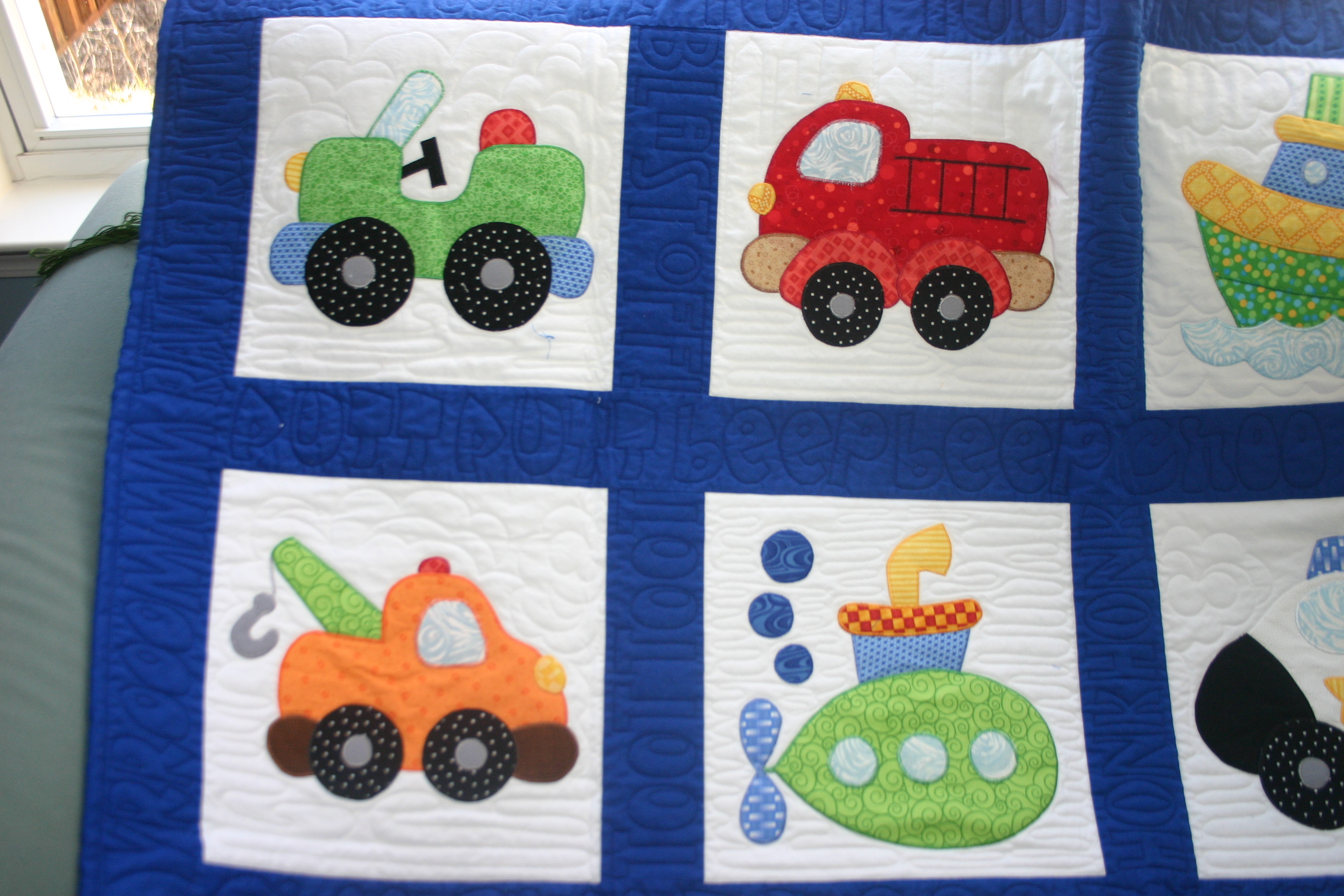
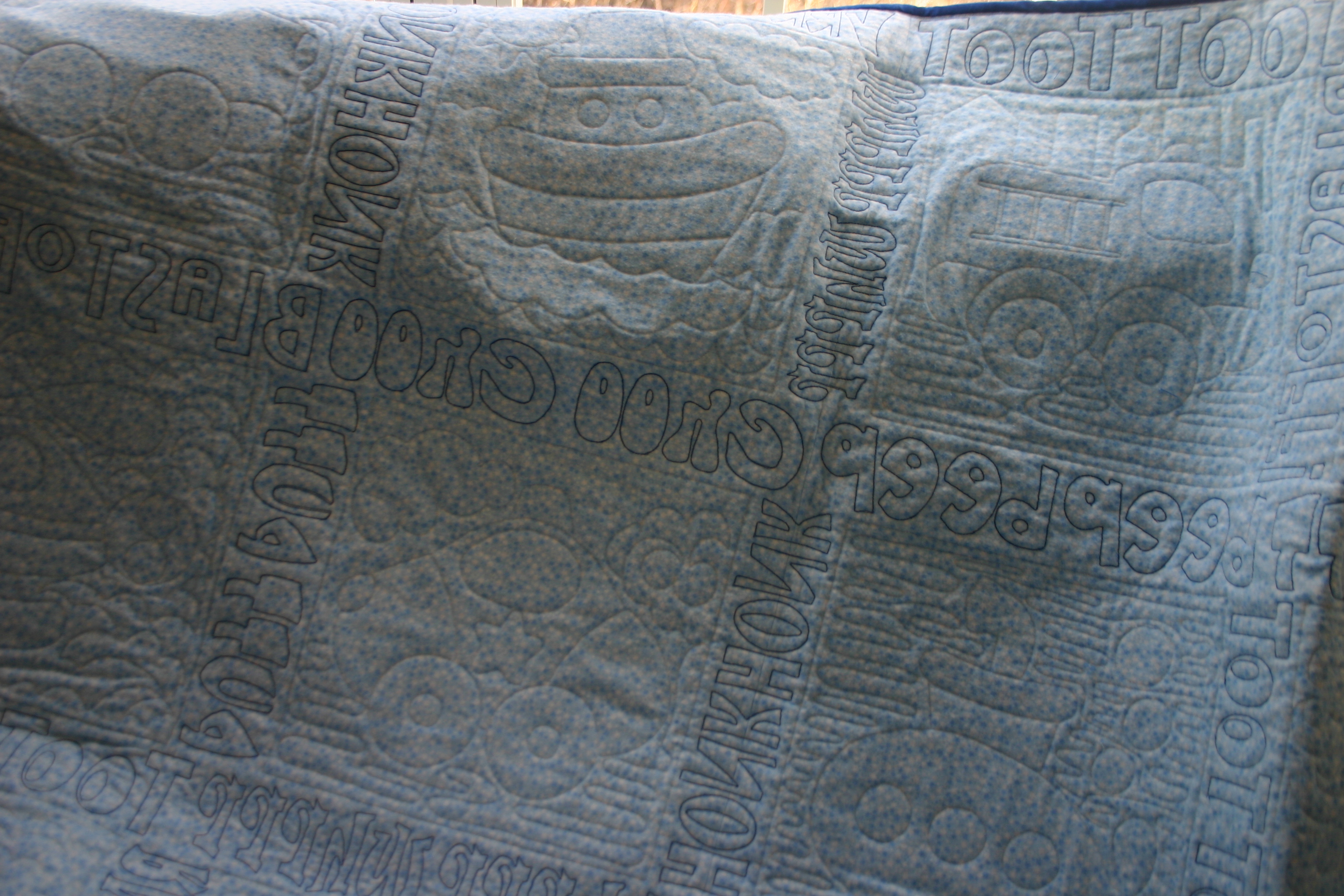
I did a lot of freehand quilting on this quilt as well as stitch-in-the-ditch and some custom scripting.
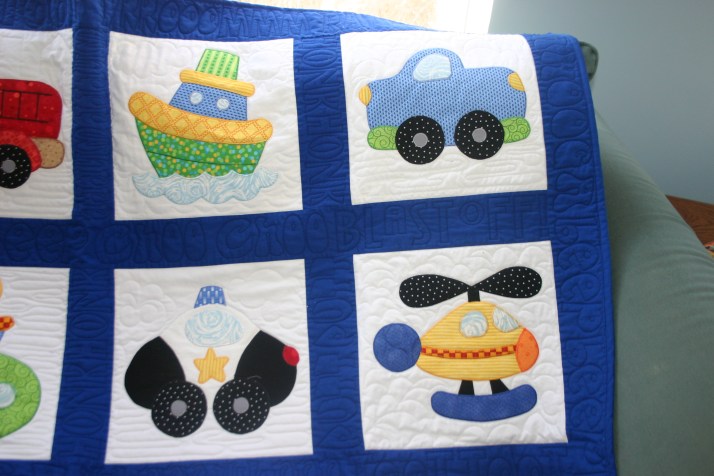
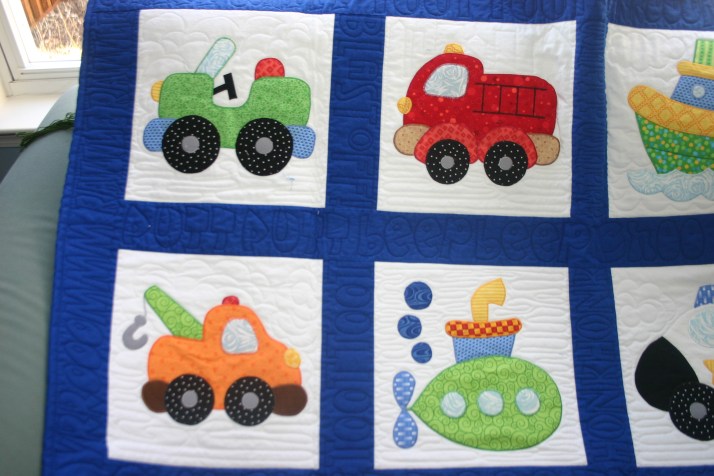
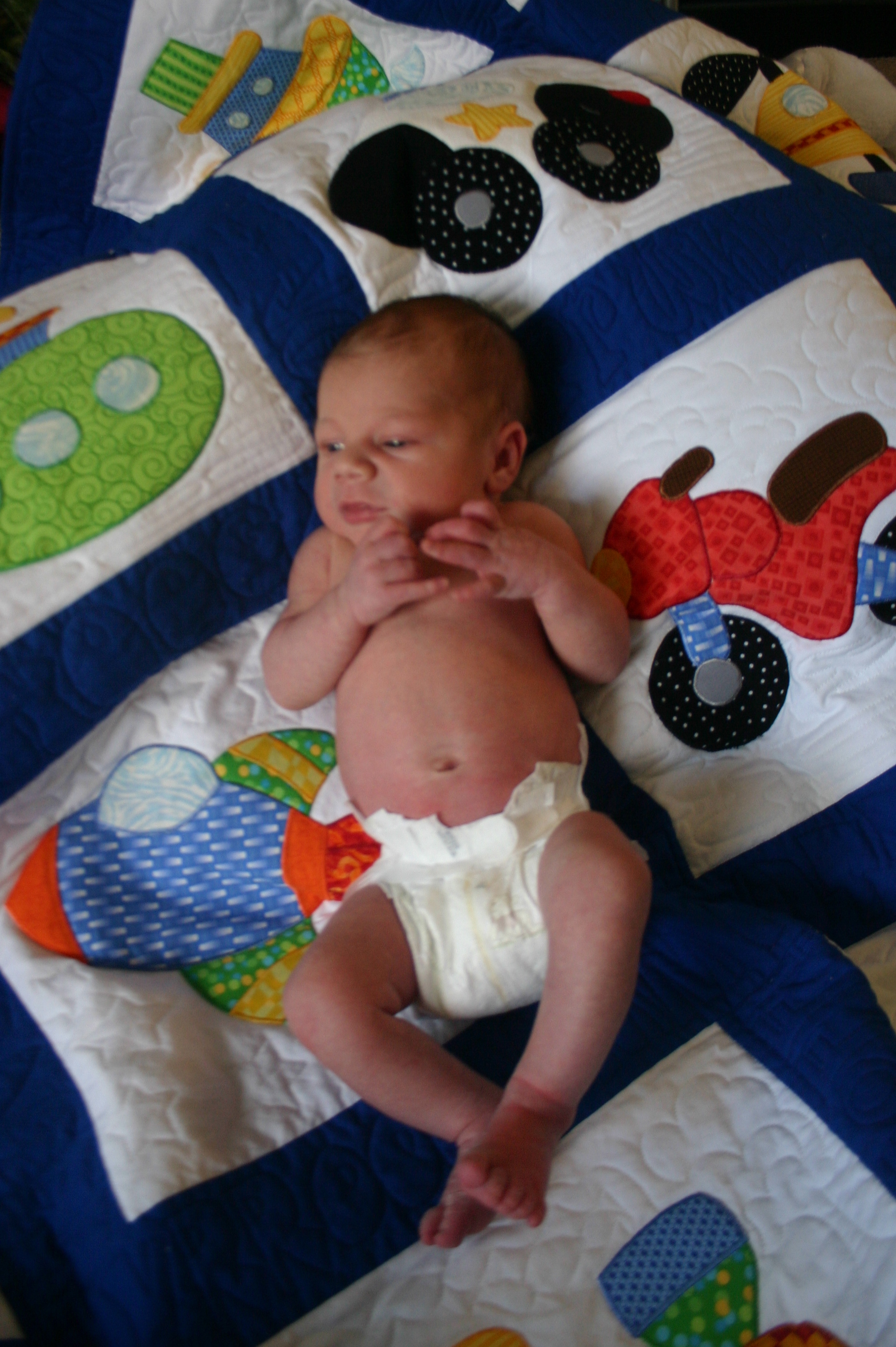
And of course one more ~ the star of the show!

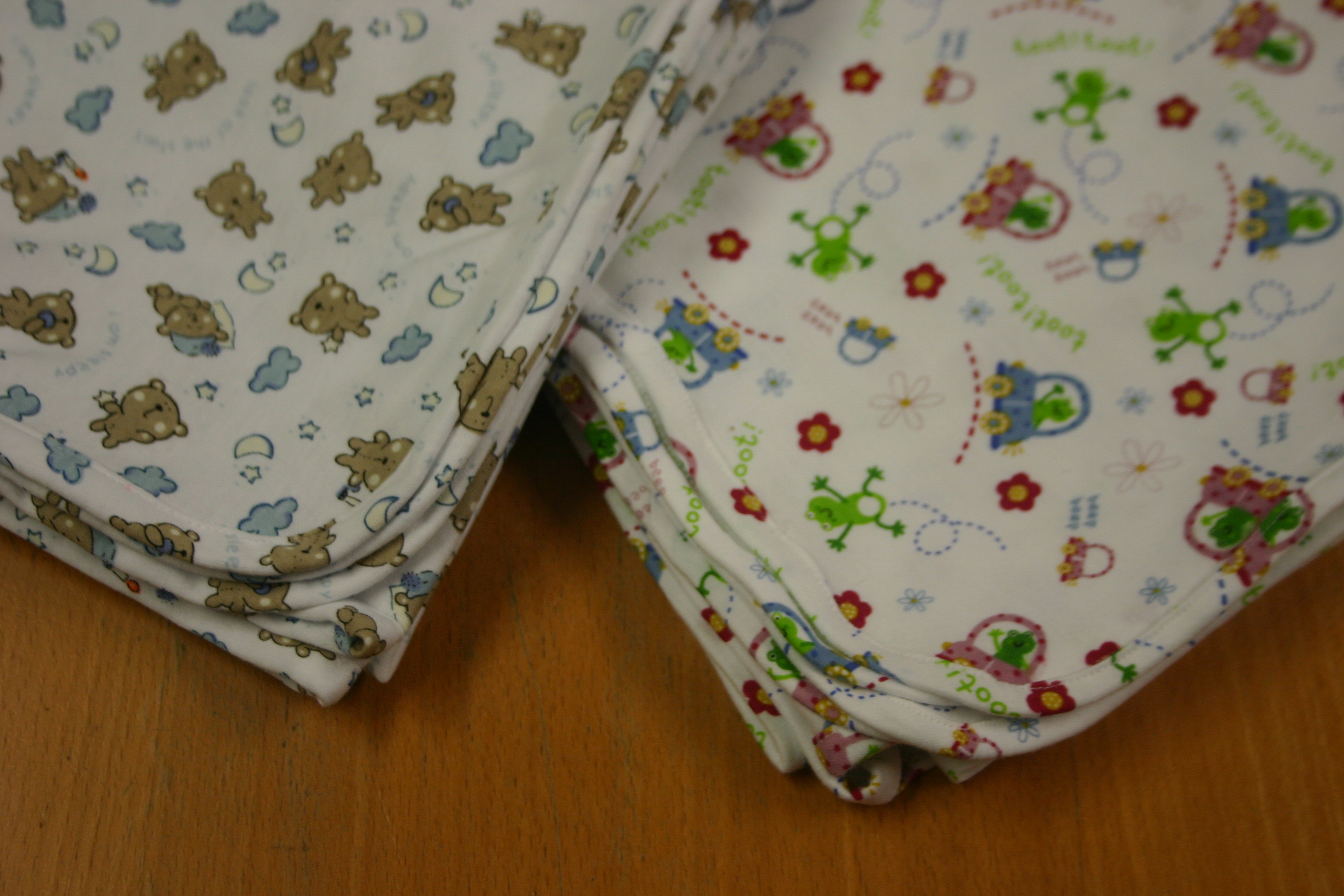
Receiving Blankets! Soft cotton jersey knits!
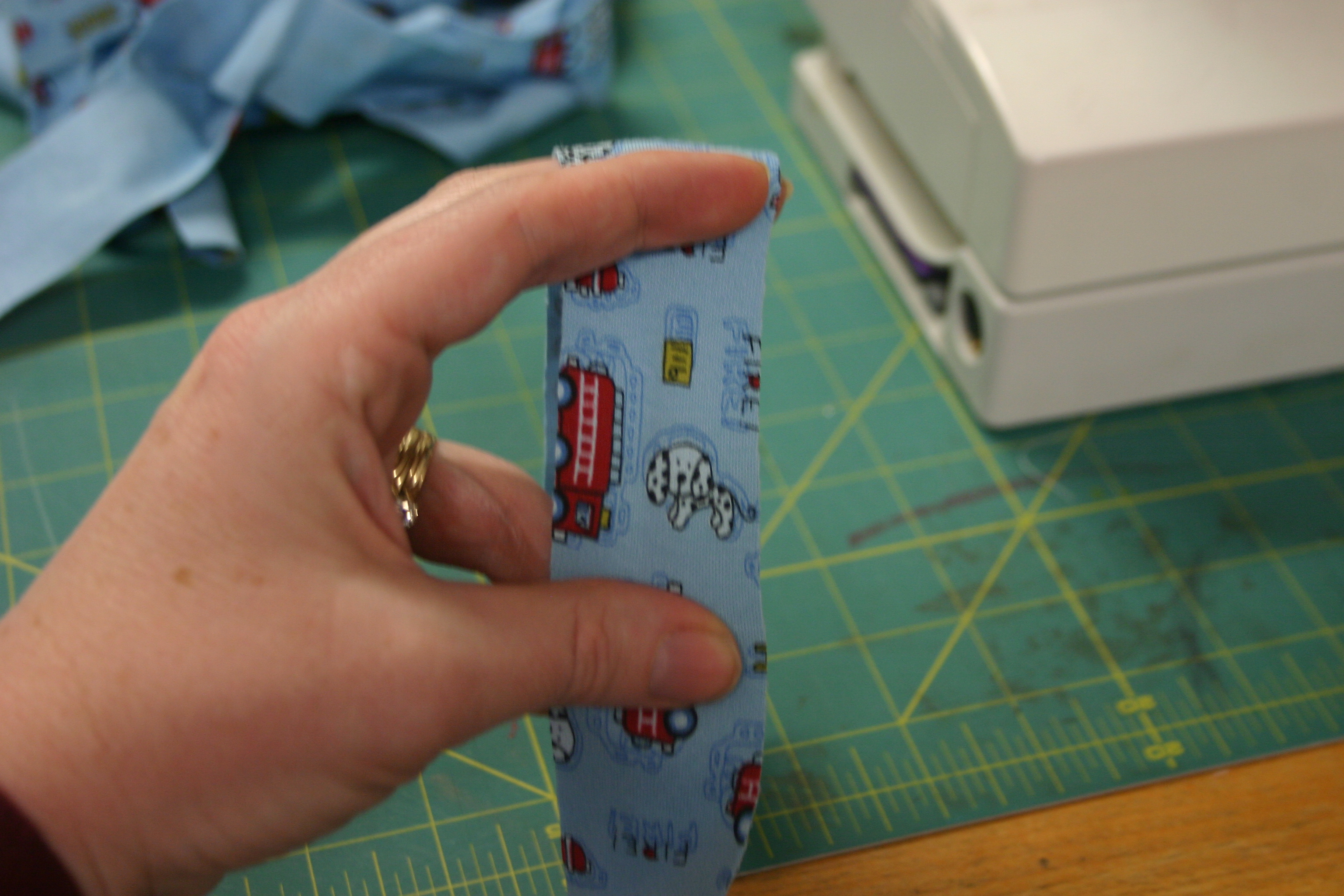
Sometime this month I am expecting the arrival of grandbaby #4!  During the Thanksgiving holiday weekend we had a baby shower for my daughter – lots of clothes & story books, but not a single receiving blanket!  So while I’ve been finishing up her wedding quilt and starting the baby’s quilt — I’ve made some over-sized receiving blankets out of cotton jersey knit.  Joann’s had some adorable prints – 58″ wide.  I bought 1-1/4 yds of four different prints – ample.

First decide your size – I chose 42-inch square for my size.  I then folded it fourths to round the corners.  Use a can or lid as a pattern.

Use a can or lid to make a square corner round.

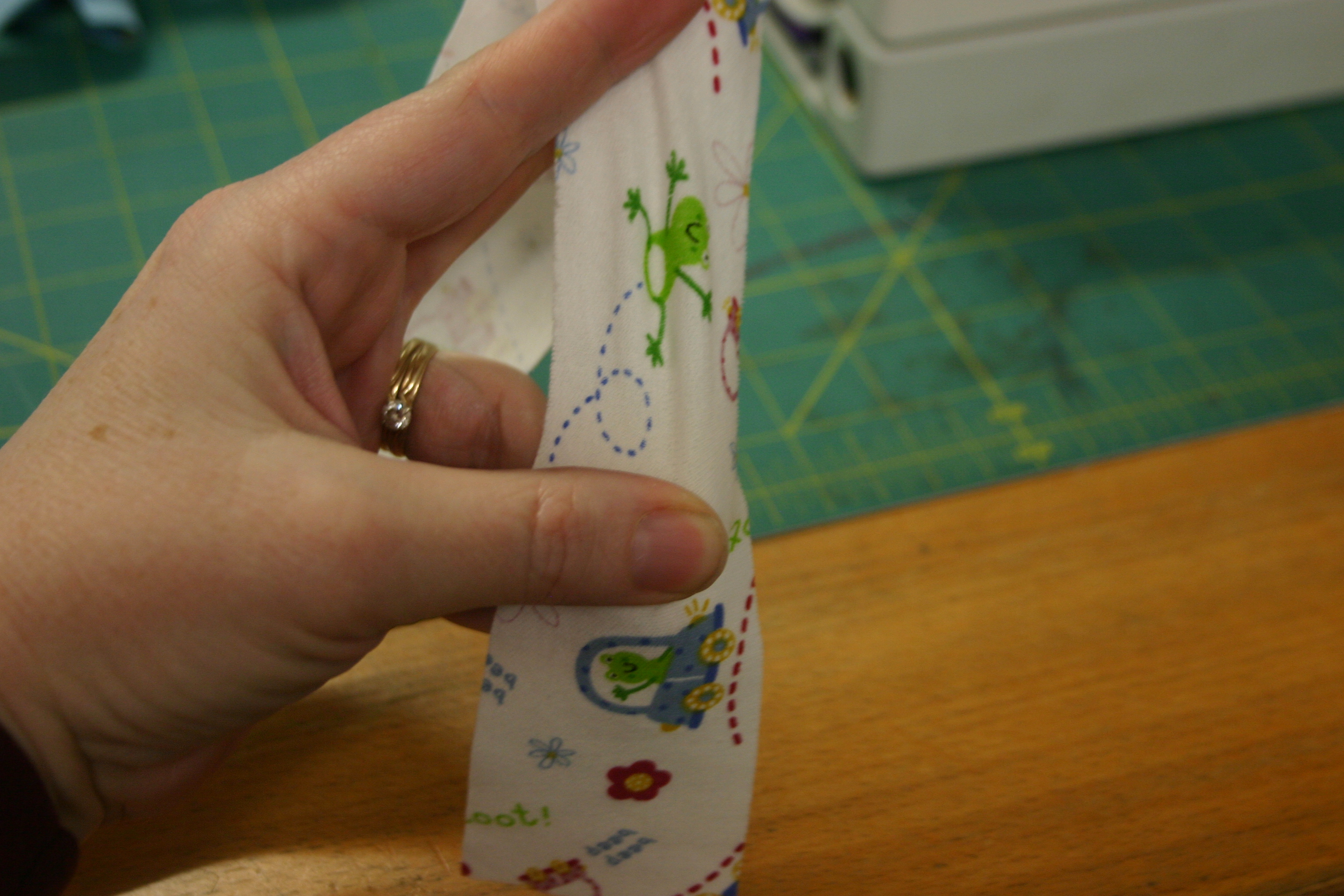
Next cut your strips for the binding – cotton jersey knit has more stretch crosswise – cut length wise instead for a more stable edge.  1-3/4 inch width worked out nicely.  

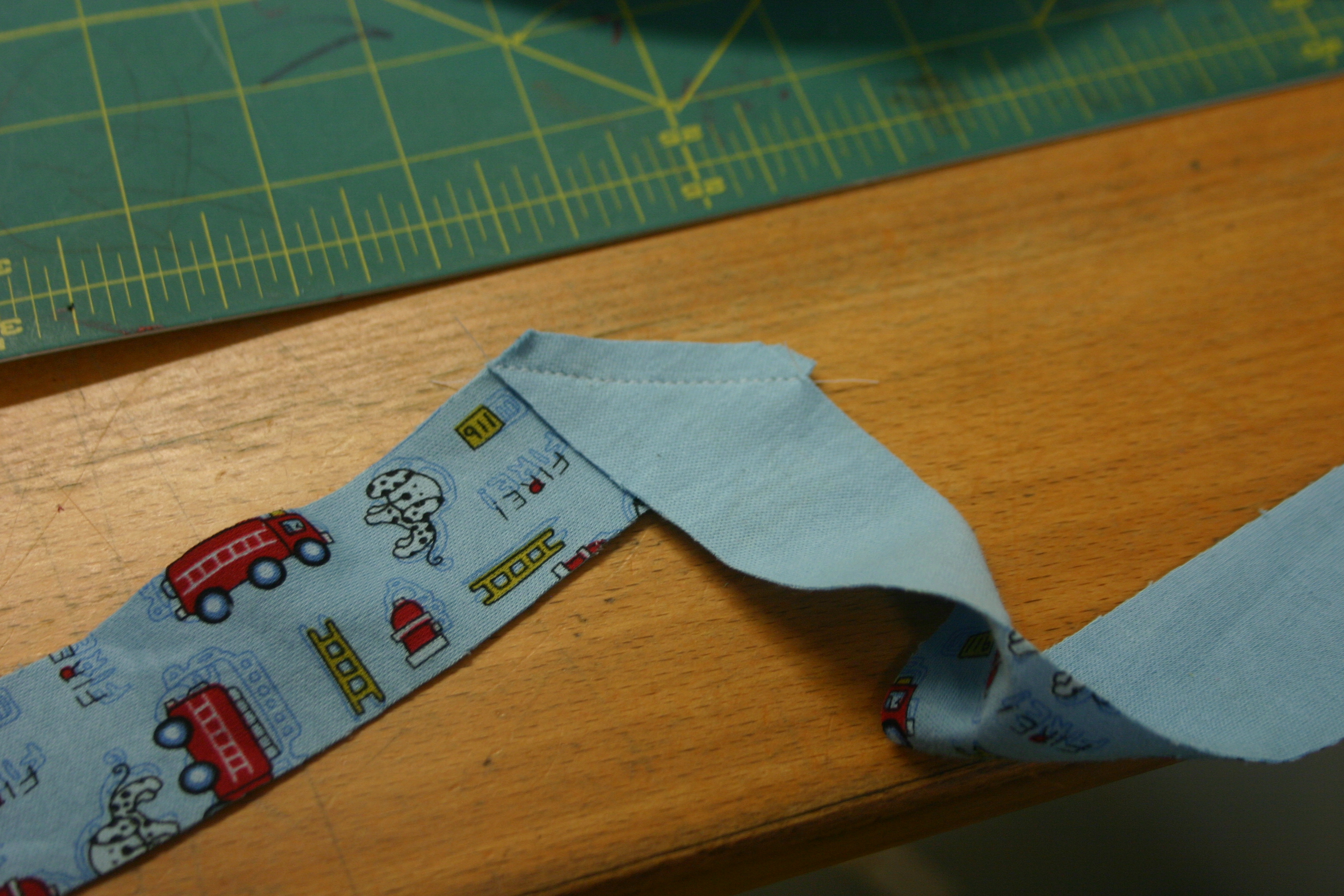
Time to join the pieces – on the bias spreads out the bulk.

Binding pieces joined on the bias.

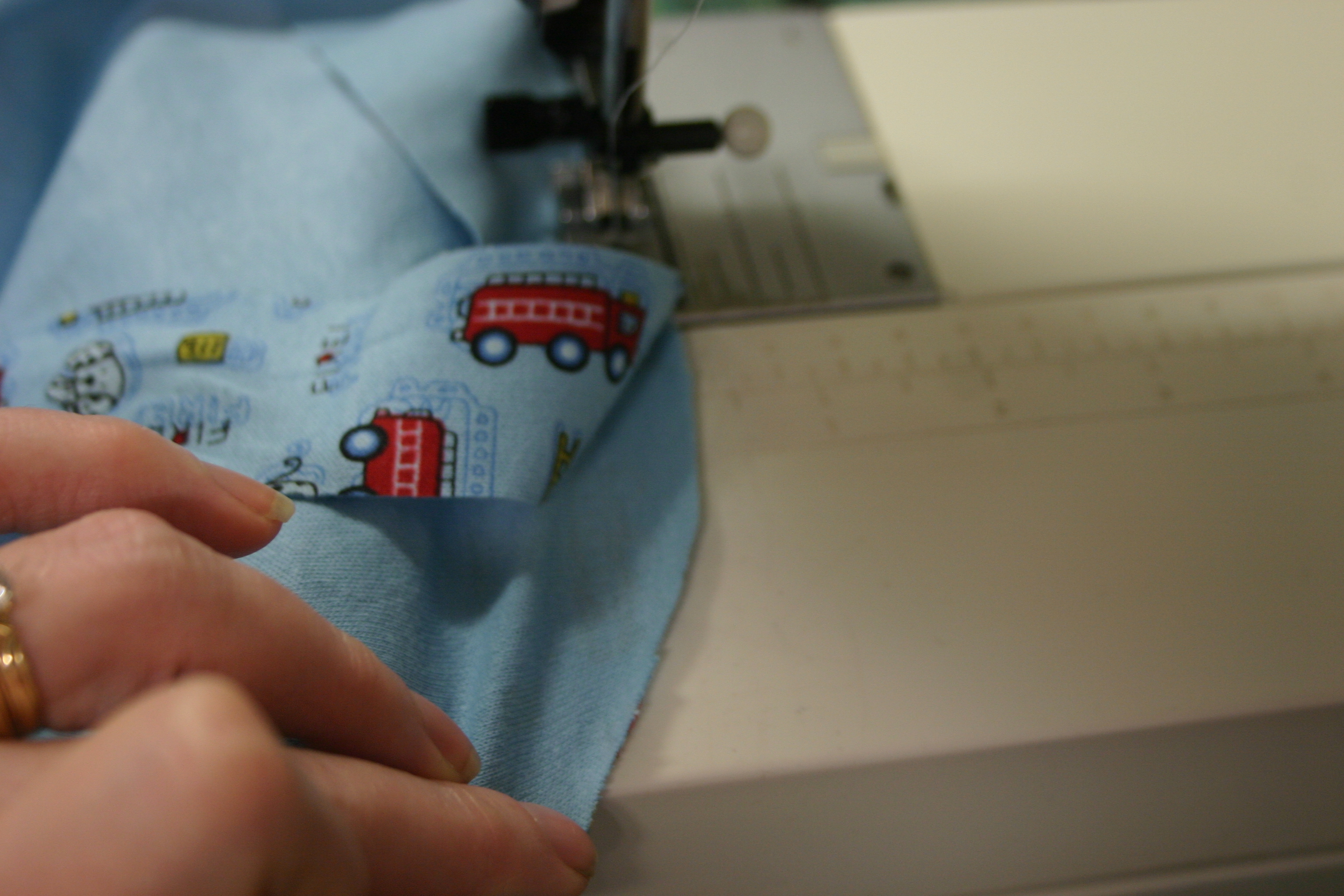
Next you’re going to sew the binding and blanket square together – wrong side of blanket to right side of binding.  Start with a tail about 6-8 inches long.  Round corners can be a bit tricky but look great when your finished – you’ll need to stretch the blanket a bit at the corner while not stretching the binding.

Stretch the blanket corner while attaching the binding. Once you get around the corner - STOP stretching.

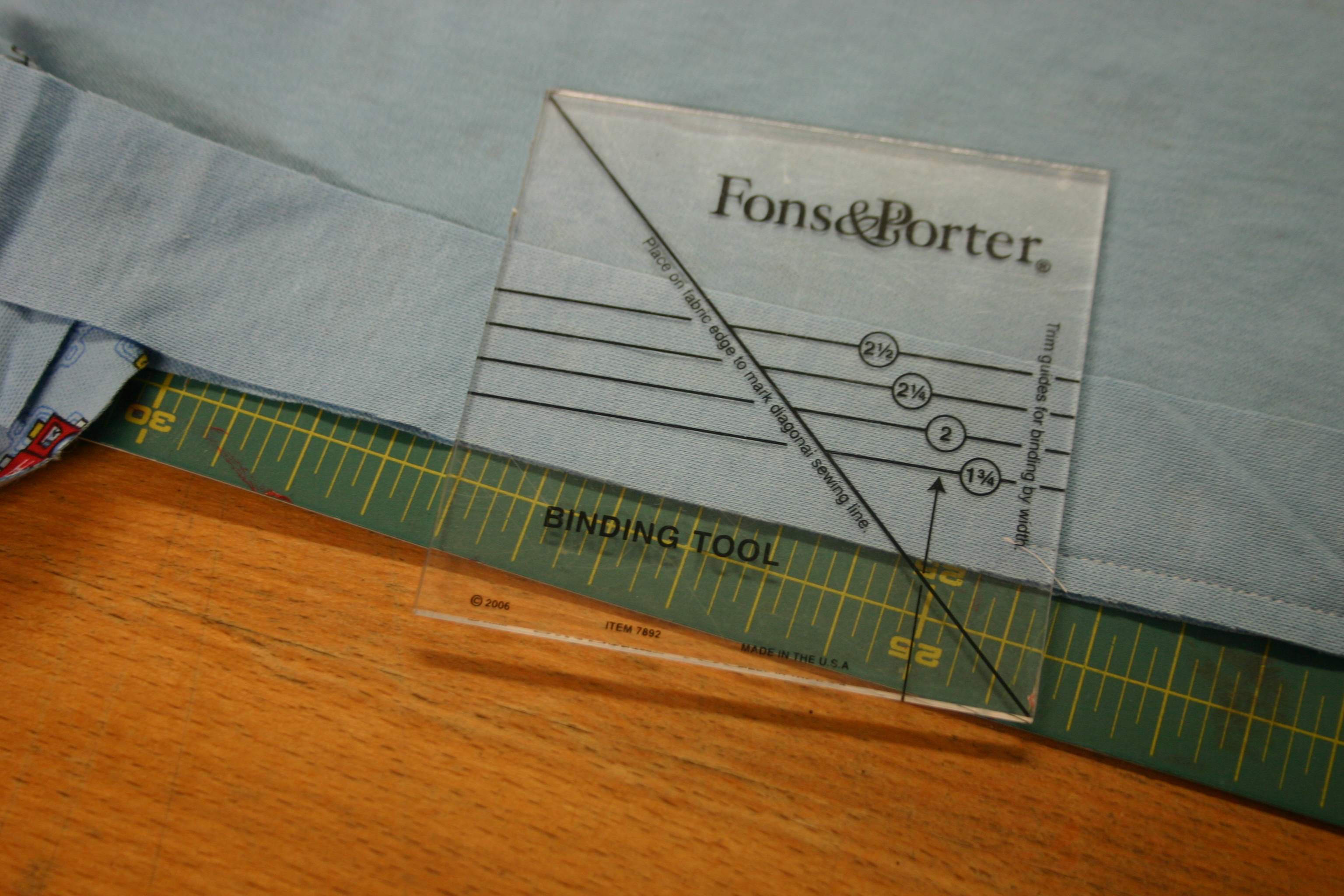
Joining the binding when you come back around is a breeze!  Really!  You can get a little measuring square to help you out

Binding tool - not necessary.

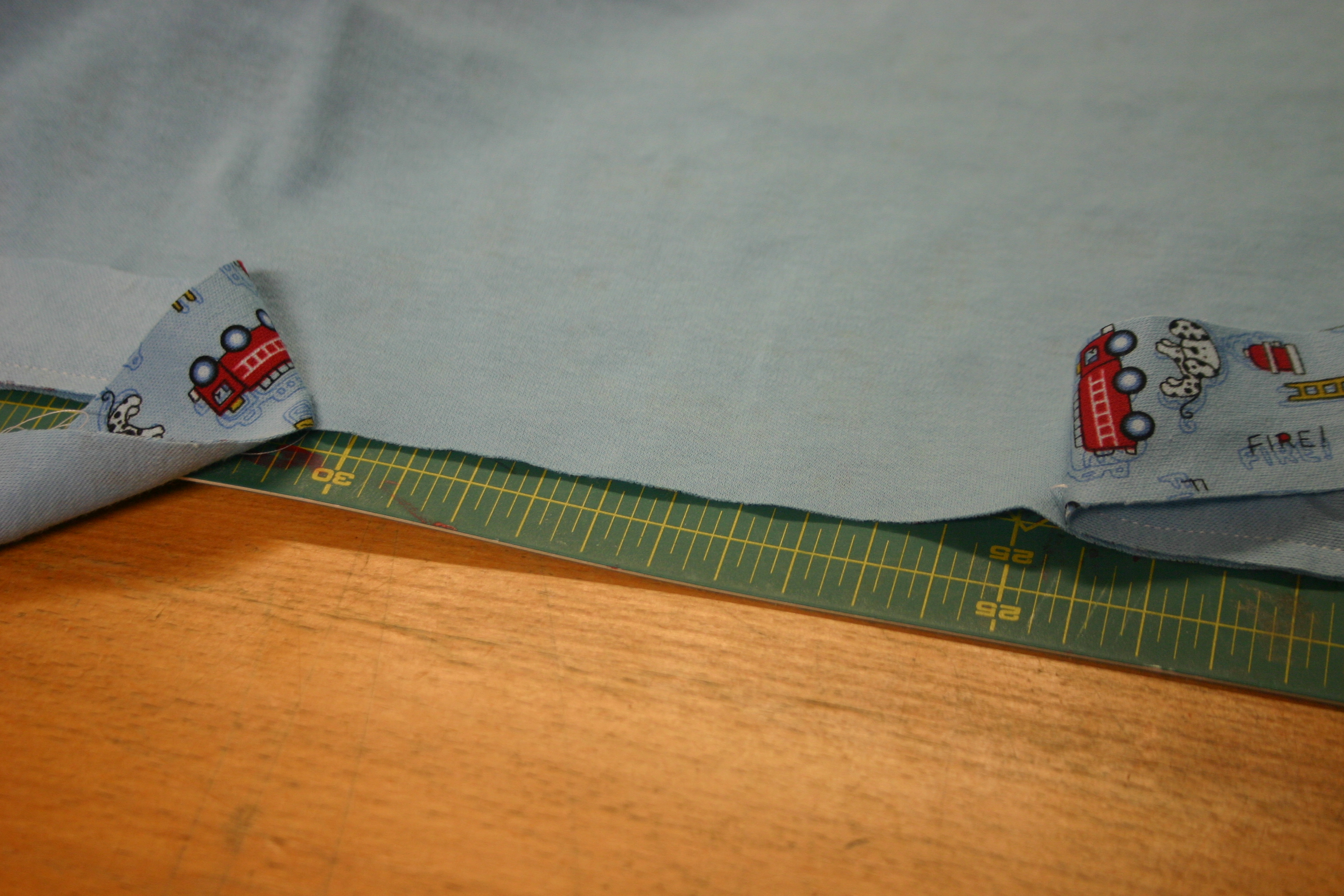
but I’m going to tell you how without the tool!  Stop stitching about 6-8 inches before you get to the start – hopefully you have two tails that overlap.

Leave a space for joining the ends.

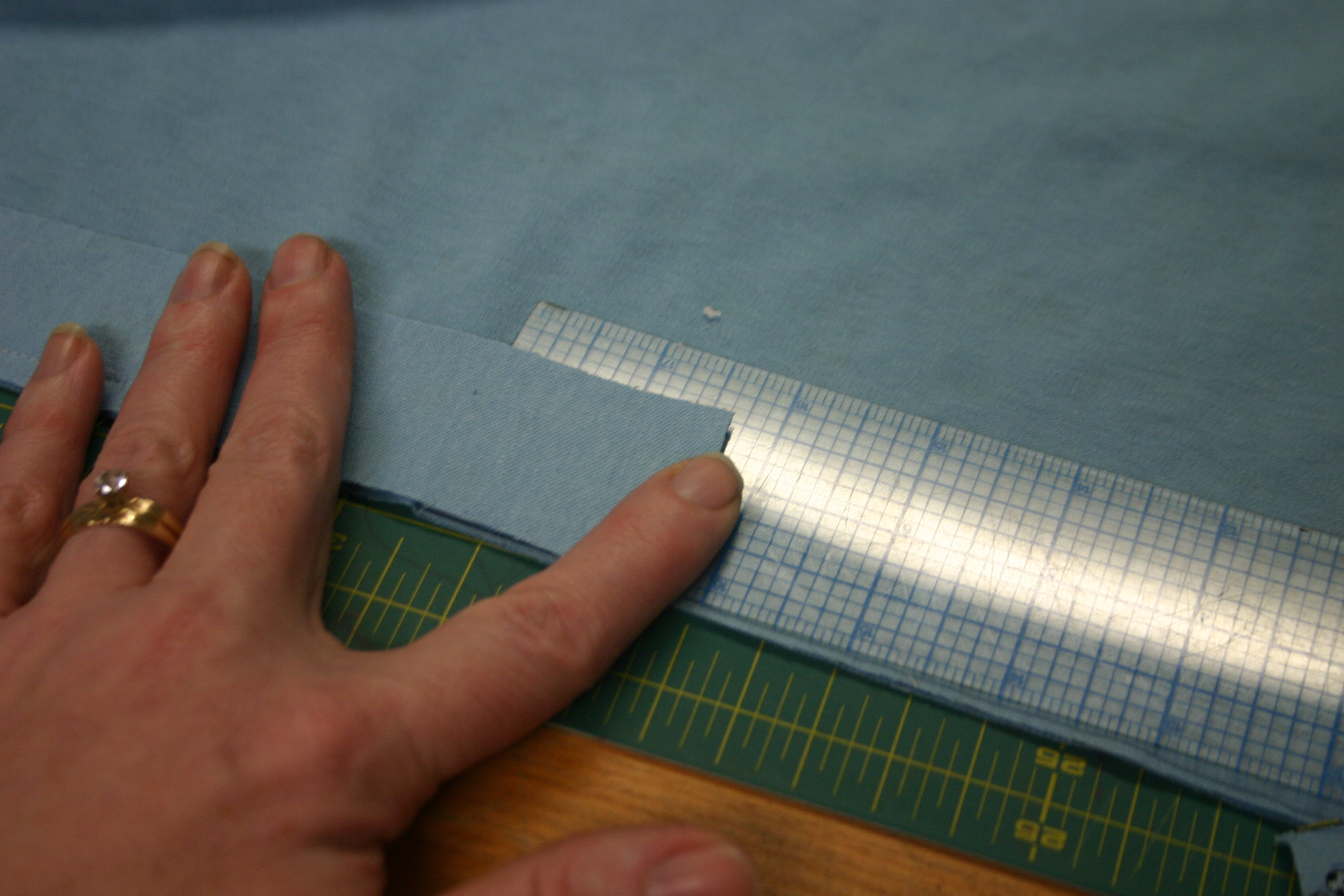
Take ONE tail and cut it straight across about mid way in the space left.  Now take a ruler and put it flush with the cut end, overlap the uncut tail over that and then make a cut at the same measurement as the width of your binding – in my case 1-3/4 inches from the end of the ruler.

Using a ruler to connect your binding ends.

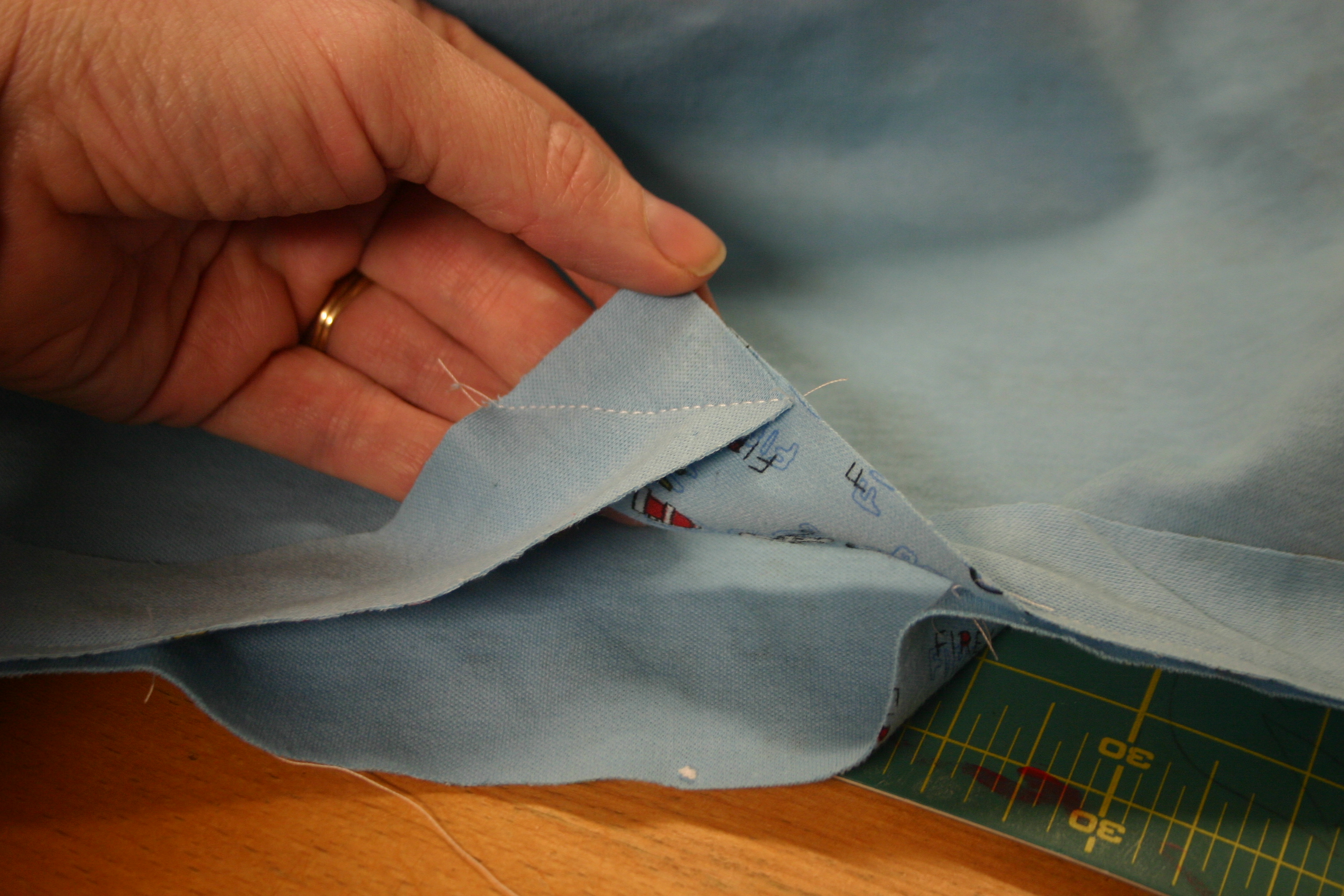
Now to connect  the two ends

Square up the ends at a right angle and sew across the bias.

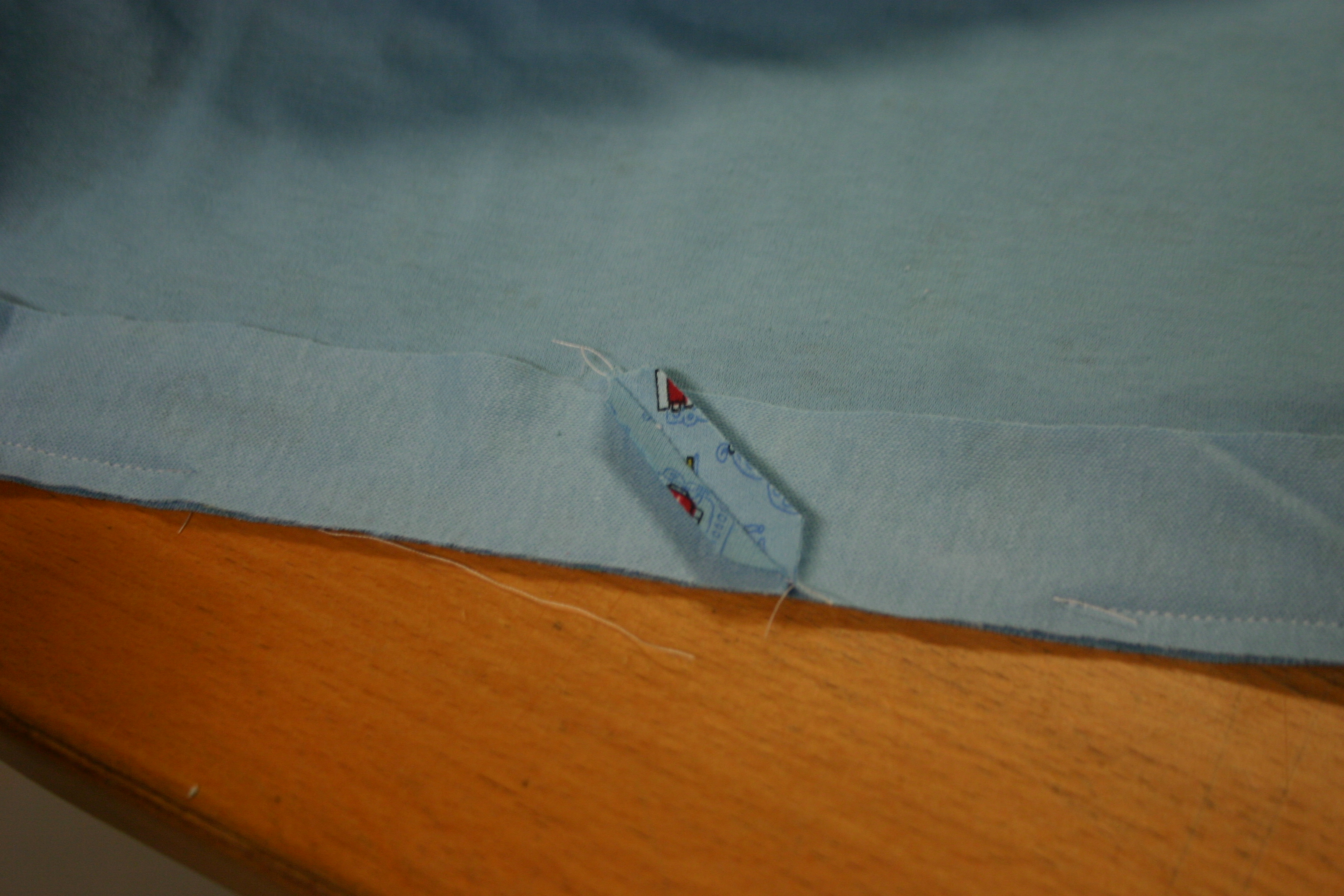
Trim off the excess, press open and it should lay nice and flat for you to finish attaching to the blanket.

Nice fit - ready to finish up.

Pressing the edges - watch your fingers! ouch!

Time to press  – press the seam toward the binding and on the raw edge of the binding fold & press a 1/4 inch allowance.

Using a stitch in the ditch foot & needle moved a few notches to the right.

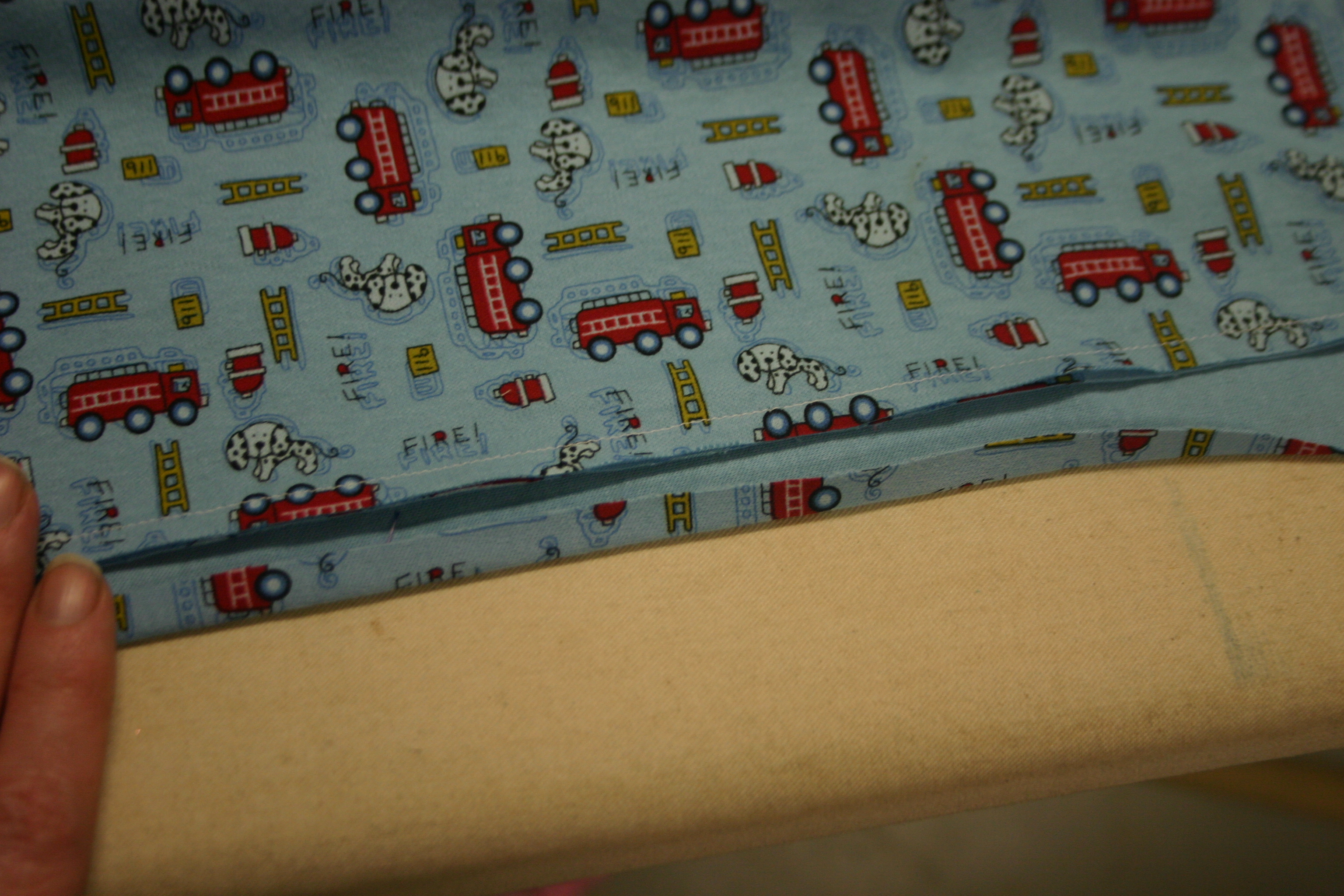
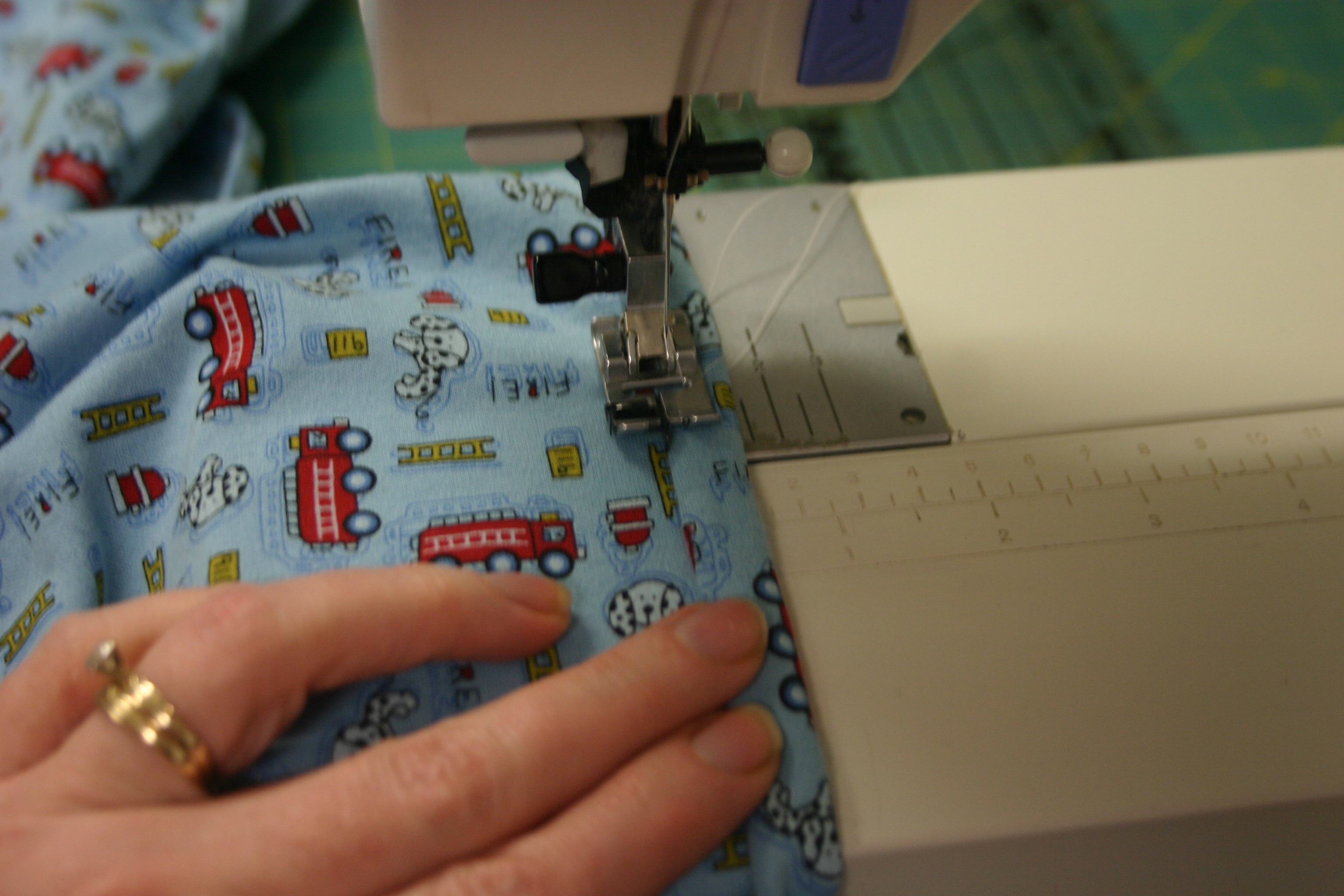
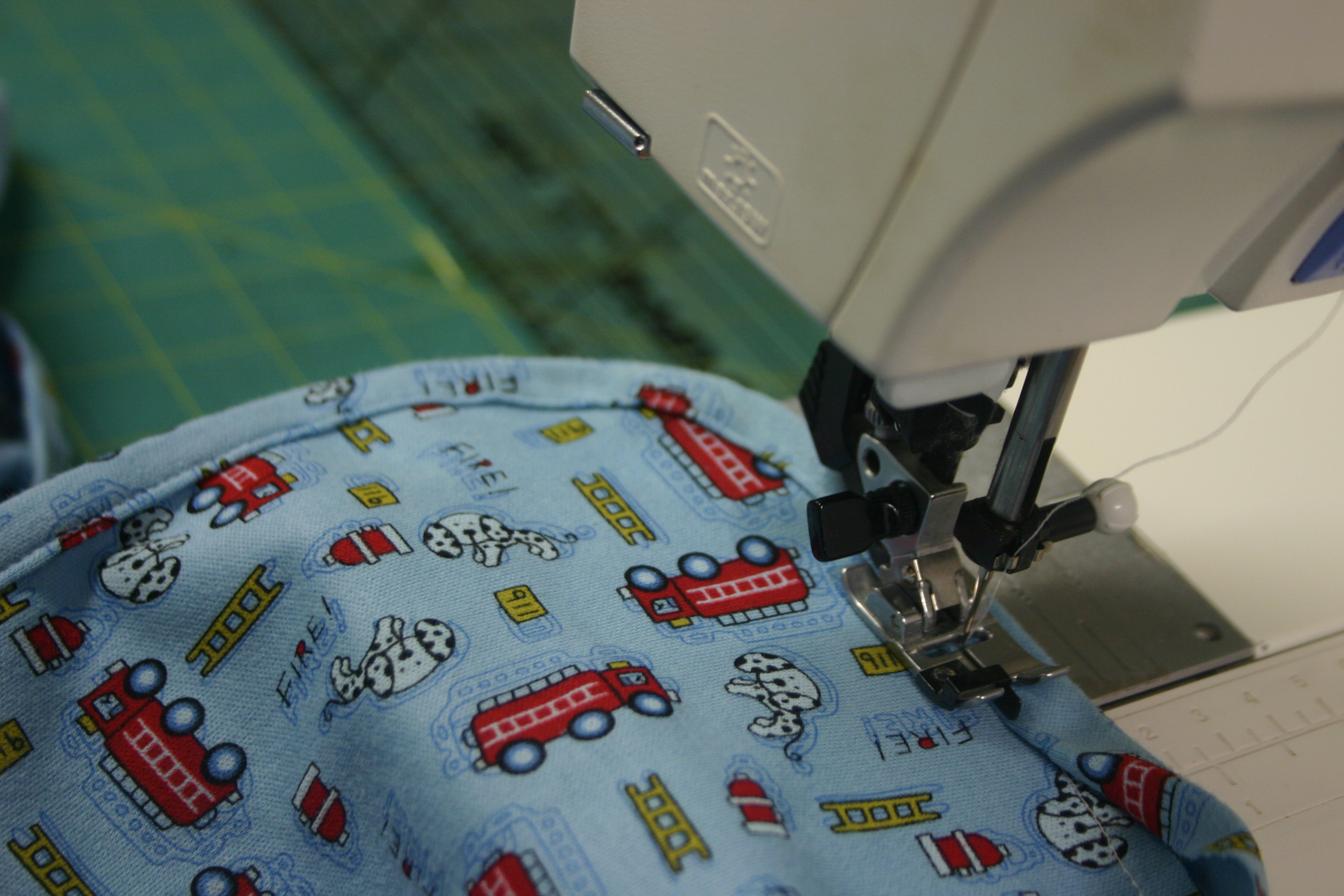
Time to sew again!  I have found using my stitch in the ditch foot, adjusting the needle location over 3 or 4 notches to the right, gets me set up for a very nice top-stitched edge.

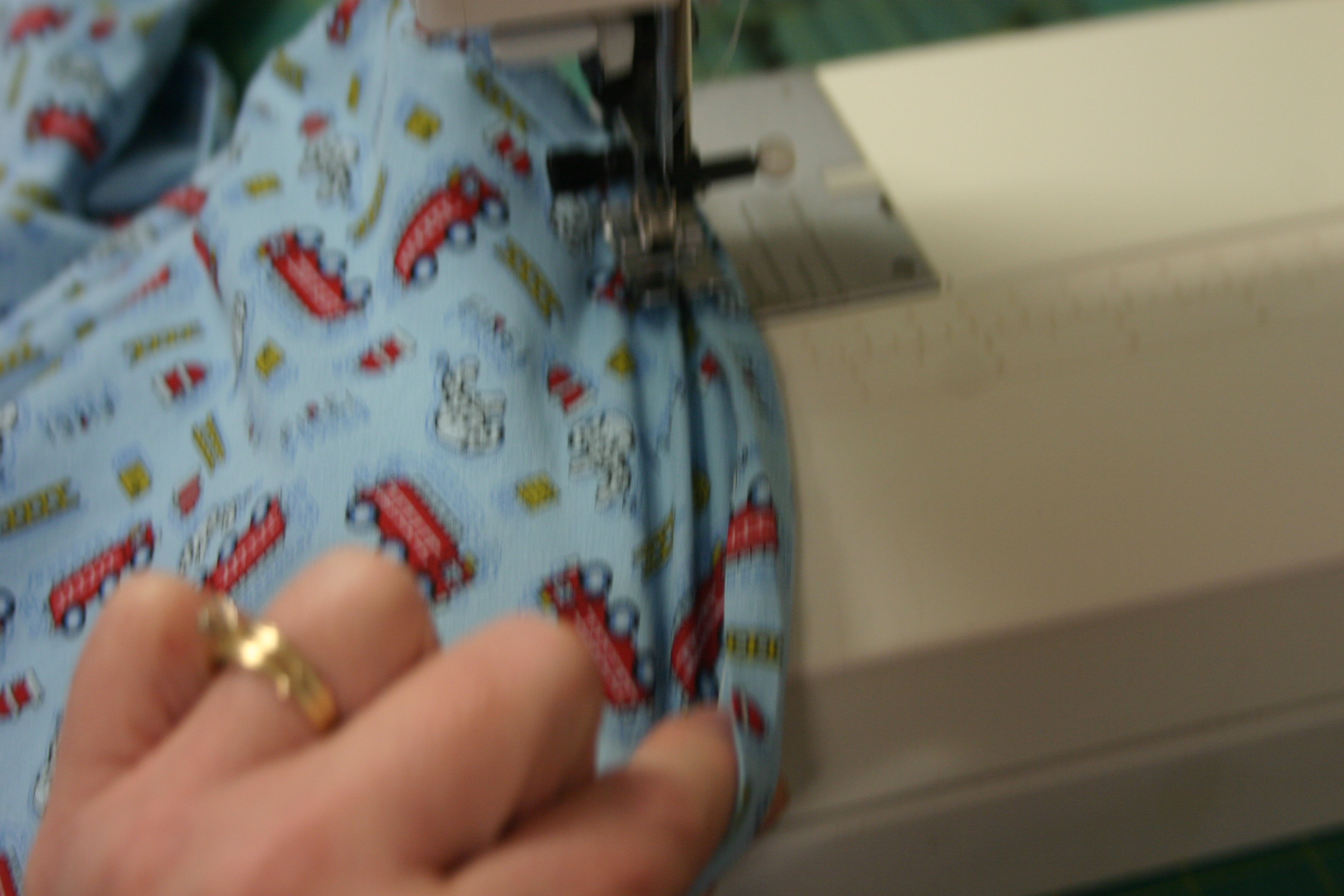
A bit blurry - you'll need to stretch it a bit to keep the binding square to itself.

Once again on the corners you’ll need to do a bit of stretch of the blanket – try to keep the binding square to the binding so you’ll need to stretch the blanket enough to do that.


Done!  Note one on the right I did with the binding cut on the crosswise – you can see a bit of wave to the blanket edges versus the one on the left lying nice and flat.

Suggestions for next month’s topic?  I’m thinking about focusing on applique – #4 grandbaby’s quilt has 16 squares of applique that I’ll be focused on for the next couple of weeks!

FYI – Why the blog?

So real quick because I’m working on a major quilting project I want done tonight….

Yahoo changed their web server that I had my website registered with.   I was considering changing to another web design/server but hadn’t had time to make the change.  In the meantime yahoo kept charging me monthly for my website that I couldn’t access or make changes to unless I upgraded to their new designer/server.  So this fall my credit card they had on file expired and I chose not to update the info, so the website is supposed to be offline – but it is still there if you want to go there – just not update-able.  It is hummingbirdhollow.us

In the meantime I started blogging for friends & family.  I noticed several other quilters & fabric store owners were doing the same and so here I am setting up to blog for my business.

There are some downsides – you can’t download my price/order form or design catalog.  But if you do want an order form or my design catalog – just post a comment here or drop me an email at longarmquilting@hummingbirdhollow.us

On the upside I don’t get charged a monthly fee by yahoo for something I can’t change.   And I can easily share what I’m working on without having to mess with html codes and stuff like I did with updating a website.

A few other answers to questions asked – batting.  I do carry it in limited quantities – primarily for my out-of-state or rural customers.  I try to encourage my clients to support their local quilt shops – they support me in allowing me to meet with customers & arrange drop-offs & pick-ups.

Locations – I have arrangements with 3 quilt shops – Quilt & Sew in Fredericksburg, Virginia; That Little Quilt Shop in Madison, Virginia and Cottonwood in Charlottesville, Virginia.   I’m open to meeting at other locations – libraries, grocery store parking lots, etc.

Due to changes at home I now go to the quilt shops on the 1st & 3rd TUESDAYS of each month – although this month I skipped going out today.   There are 5 Tuesdays this month and with a grandbaby expected this month I’m being a bit off schedule.  I will probably be out at the shops next Tuesday – January 10th.  And then depending on the baby – either Jan 24 or Feb 7th.    If you’re in Fredericksburg area and want to meet otherwise just drop me an email or call me  (540)846-9982 – I’m in town with kids’ activities other days of the week and can work something out.

Well – back to finishing a quilt!   Again feel free to post a comment here, drop me an email or give me a call!


Welcome!

Not quite ready to get the blog going but it is ready & waiting for me to fine tune it by the first of the new year!

I’ll be posting quilting & sewing tips, my projects – quilts, designs & what-nots, favorite customer quilts and more.  Be sure to subscribe so you keep updated on news!

Helen